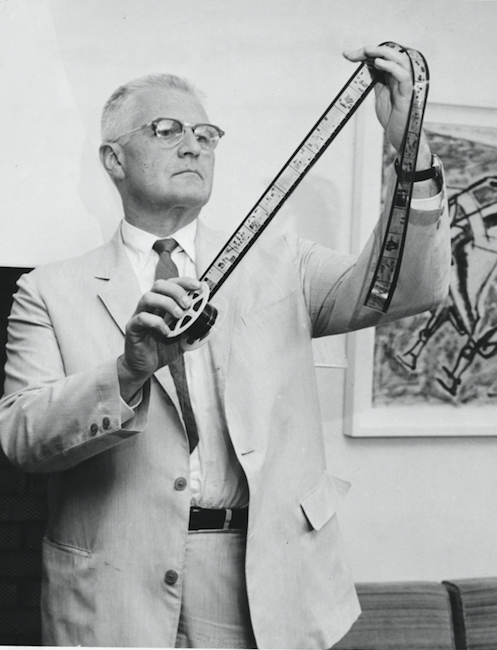
Eugene Power inspecting microfilm. From the Internet Archive’s collections.
Europe circulated its theses by printing each one by the hundred. America’s answer was the opposite: one typescript, one camera, and a company in Ann Arbor that would make and sell a copy to anyone who asked — an edition of one.
In our last post we told the story of the great European dissertation exchange — every thesis printed in bulk and shipped to many libraries for fee access. America when in a more commercial direction. By the Second World War most American universities had stopped requiring graduate students to publish their dissertations in book form; a thesis was a typescript in the degree-granting library, available only on interlibrary loan. Even where publication fees survived — Michigan charged $75 “in lieu of publication” (Power, Edition of One, p. 89) — the printed theses that did circulate were sometimes difficult to locate and borrow.
The man who changed that was Eugene Power. He had spent his nights in 1936 in a rented darkroom behind Ray Dolph’s funeral parlor in Ann Arbor, filming rare English books for American libraries, and in June 1938 he left his job to found University Microfilms on an inversion of the economics of publishing: presses are efficient only in bulk, but with microfilm you film a work once and print a copy only when someone asks. A book could be published profitably in an edition of one — the title he later gave his autobiography. (Other visions for microfilm are fascinating involving Robert Binkley and Vannevar Bush, but this have to wait).
Dissertations were the perfect case for Power’s vision. One of his first acts was a pamphlet, A Plan for Publication of Scholarly Material by Microfilm: the university sends each dissertation to Ann Arbor; UMI films it and vaults the master negative; the abstract is printed in a catalog — Microfilm Abstracts, later Dissertation Abstracts — distributed free to two hundred of the world’s leading libraries; and any scholar who finds something promising orders a copy of the full text, made on demand — in those years a positive print of the film itself. Total cost to the student: $15, “less than the cost of typing it.” Where Europe shipped printed copies of the thesis itself, Power shipped two hundred copies of the abstract and copied the rest only when asked. Paper came two decades later: around 1957 Power watched a Xerox Copyflo enlarge microfilm onto a continuous paper web and realized the vault could print books — “At last I could truly publish a single copy of a work ‘on demand’ without compromise” (p. 229) — and dissertations could be ordered as bound, acid-free paper books printed from the master negative.
The wartime chapter. The war made the case for film. Power’s cameras kept running in the British Museum under a Rockefeller grant, rare books and manuscripts crossing the Atlantic as film to subscribing American libraries while London was bombed; at home UMI filmed eight million pages of ship manifests for the Justice Department and printed the tens of thousands of engineering drawings behind the P-51 fighter. Copies, again, as a hedge against catastrophe. (Power, Edition of One, pp. 139–142)
A decisive moment came on January 26, 1952, when the Association of Research Libraries, meeting in Iowa City, took up the report of Ralph Ellsworth’s committee on the publication of dissertations: that all doctoral dissertations be published, that micropublication was suitable, and that ARL members join an enlarged Microfilm Abstracts program. The costs were “sharply attacked” in discussion — and “a motion to adopt the report was carried” (“Brief of Minutes, Association of Research Libraries,” College & Research Libraries 13, no. 3, July 1952, p. 254). Ellsworth later recalled the mission as closing a “gap in the distribution of the literature of scholarship,” with the film negatives “considered as the archival copy” kept in UMI’s vaults (Ellsworth, quoted in Power, pp. 165–166). Graduate schools across the country signed on. By the time Power wrote his memoir in 1990, UMI was publishing 98 percent of all dissertations accepted by American institutions each year.
Xerox announced its acquisition of University Microfilms on February 20, 1962 — an exchange of stock the trade press valued at almost $7.9 million — with Power staying on to run it as a wholly-owned subsidiary — until 1970, eight years later, when a new Xerox mandatory-retirement policy forced him out at sixty-five, over his objections (Power, pp. 317–318) (“Xerox Corporation Acquires University Microfilms, Inc.,” Publishers’ Weekly, March 5, 1962, p. 36). Xerox’s longtime research chief John Dessauer remembered it the same way in his own memoir — “The acquisition of University Microfilms was completed in 1962” — and quotes the report to Xerox shareholders: 85 percent of all American doctoral dissertations were by then being filmed through arrangements with 135 universities, with over sixty-two thousand dissertations on file (Dessauer, My Years with Xerox, pp. 166–167); the operation later passed to Bell & Howell and became today’s ProQuest, whose dissertation database — the direct descendant of Power’s vault — holds several million theses and remains, for much of 20th-century American scholarship, the only copy outside the degree-granting university.
Set the two systems side by side and you can see what each traded away. Europe’s exchange put a hundred and fifty copies in a hundred and fifty buildings (Joan Ash, “The Exchange of Academic Dissertations,” College & Research Libraries, May 1969, p. 239) — magnificent redundancy, but no central catalog and, as Leiden’s uncatalogued stacks remind us, no guarantee anyone could find a given thesis. America’s microfilm put every thesis in one catalog, findable and orderable — but the masters sat in a single corporate vault, and access ran through a single company, as it still does.
Findable and safe
The lesson of the 20th century is that circulation needs both: many copies, and one catalog. That is what the program at the Internet Archive Europe is starting to build for the world’s theses. More on this in other posts.
Posted inUncategorized|Comments Off on An Edition of One: US Theses and Dissertations on Microfilm
For a century, the universities of Europe ran a remarkable system for copying and circulating dissertations they produced. Then the web arrived, and we quietly stopped. Here is that story — and pointing to how the Internet Archive Europe hopes to help.
(by Brewster Kahle and Claude)
Long before anyone spoke of open access, Europe’s universities had already solved the problem of sharing scholarship — with printing presses, shipping crates, and standing agreements between libraries.
The system was called, in German, the Dissertationentausch — the dissertation exchange. From the late nineteenth century well into the twentieth, a doctoral candidate at a German, Swiss, Dutch, or Scandinavian university could not simply hand in a typescript and collect a degree. The university required the dissertation to be printed in bulk — in Germany usually 150 or more copies (Joan Ash, “The Exchange of Academic Dissertations,” College & Research Libraries, May 1969, p. 237), deposited with the university library as a condition of graduation.
The library kept a few copies. The rest went into crates.
Through exchange offices — Tauschstellen — each university shipped its dissertations to partner universities across Europe and around the world, and received theirs in return. No money changed hands. A research library in Uppsala or Leiden or Chicago accumulated a nearly comprehensive collection of the doctoral output of dozens of other universities, year after year, without purchasing a single volume. In 1958, UNESCO formalized what the libraries had long practiced, with two international conventions on the exchange of publications.
The French chapter. France ran its own version: university theses were printed and exchanged from the 1880s onward, and in 1971 the system was modernized through the Atelier national de reproduction des thèses (ANRT) in Lille, which reproduced every French doctoral thesis on microfiche and circulated it to university libraries nationwide. In the United States, University Microfilms played a similar role on film.
What the exchange quietly achieved
The exchange was built for access — a scholar in one city could read the dissertations of another. But its greatest achievement was one nobody had to argue for: preservation through redundancy. Every thesis existed in dozens or hundreds of copies, scattered across libraries on several continents. Wars, fires, floods, and institutional collapse could destroy any one collection, and did — and the scholarship survived, because no single building held the only copy.
Librarians today have a slogan for this principle: lots of copies keep stuff safe. The dissertation exchange practiced it for a hundred years before anyone needed to say it out loud.
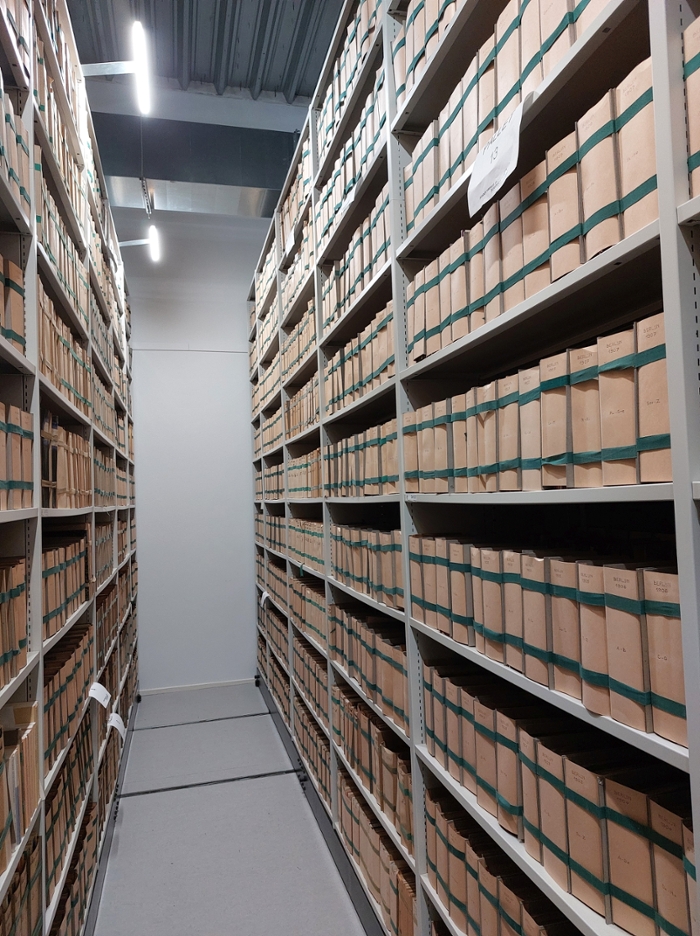
Printed theses in the stacks at Leiden — bundle after bundle, aisle after aisle.
The scale of what accumulated is hard to overstate. The University of Leiden, a hub of the exchange for generations, built one of the world’s great collections of printed theses — so vast that many of them remain uncatalogued to this day: scholarship that was faithfully copied, shipped, and shelved, and is still waiting to be found. The library told the collection’s story in its 2005 exhibition catalog Hora est! On dissertations (archived) — “Hora est,” “it is time,” being the cry that ends every Leiden doctoral defense.
Then we stopped
Between the 1980s and the 2000s, the printing requirements were dropped, one country at a time. Microfiche came and went. Electronic deposit arrived, and it was a genuine advance: today a thesis goes into a university’s institutional repository, discoverable by anyone with a browser, at no cost to the student.
But look at what happened to the copies. Where the exchange put a hundred and fifty copies of each thesis in a hundred and fifty buildings, the digital thesis typically lives on one server, at one institution. If that repository is migrated carelessly, defunded, restructured, or attacked, the scholarship is simply gone — or dark for years. This is not hypothetical: EThOS, the British Library’s national e-theses service holding records of half a million UK doctorates, has been offline since a cyberattack in 2023. Links rot; repositories move; universities merge and close. We replaced the most redundant scholarly distribution system ever built with the least redundant one.
Research report · Internet Archive holdings · 17 August 2026
Short answer: the engineering trade press litigated every element of the modern datacenter backup-power design between 1996 and 2010, and settled it — a standby generator plus a flywheel sized to the ~10 seconds the generator needs to start. We read ~1,950 issues of nine periodicals in the Internet Archive’s scanned collections (59 feature articles in full) while specifying a 400 kW natural-gas emergency plant, and this is what the record says.
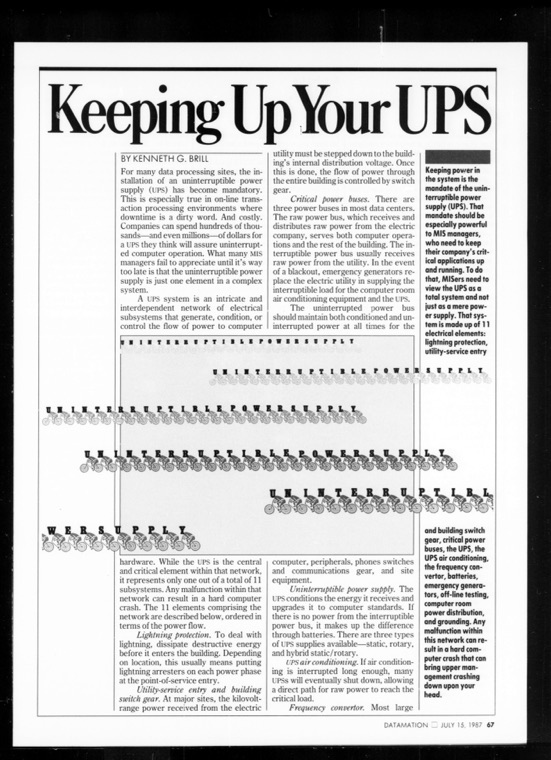
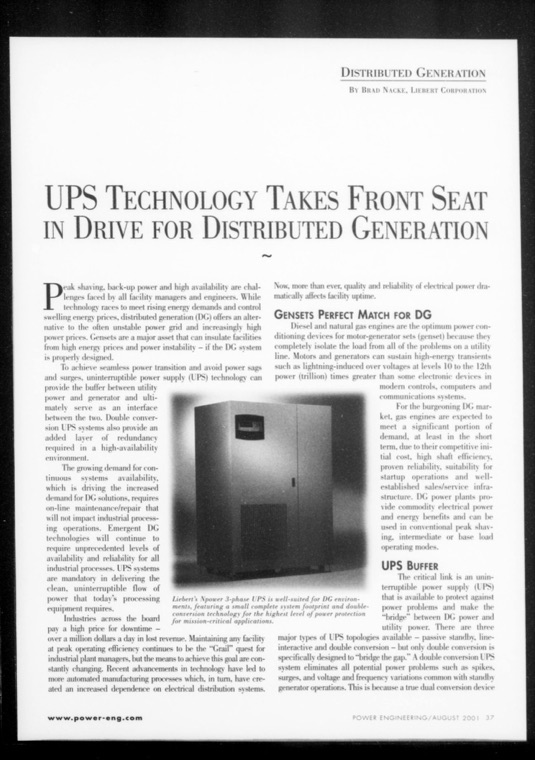
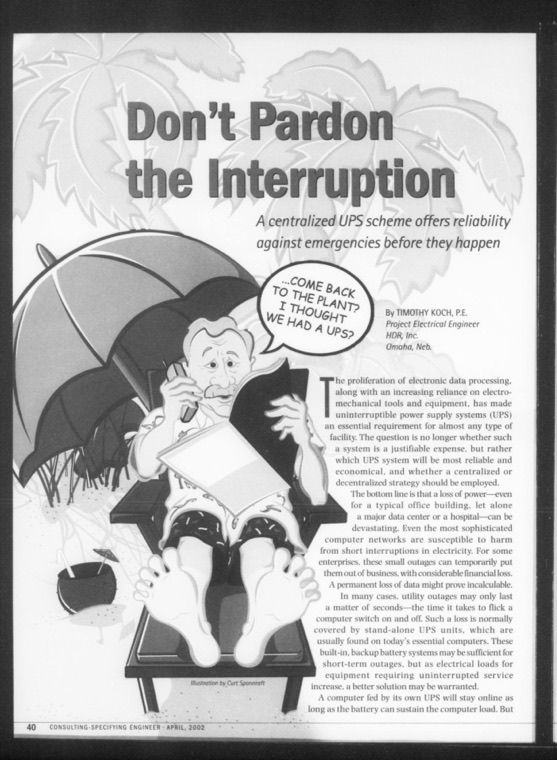
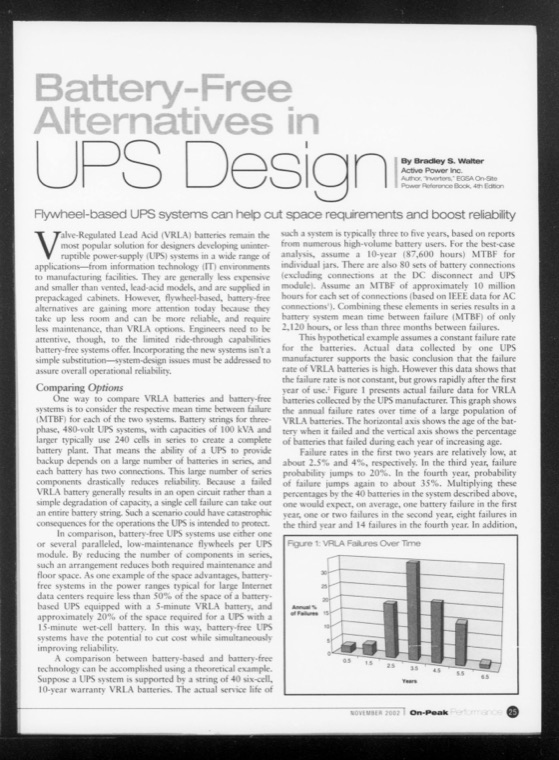
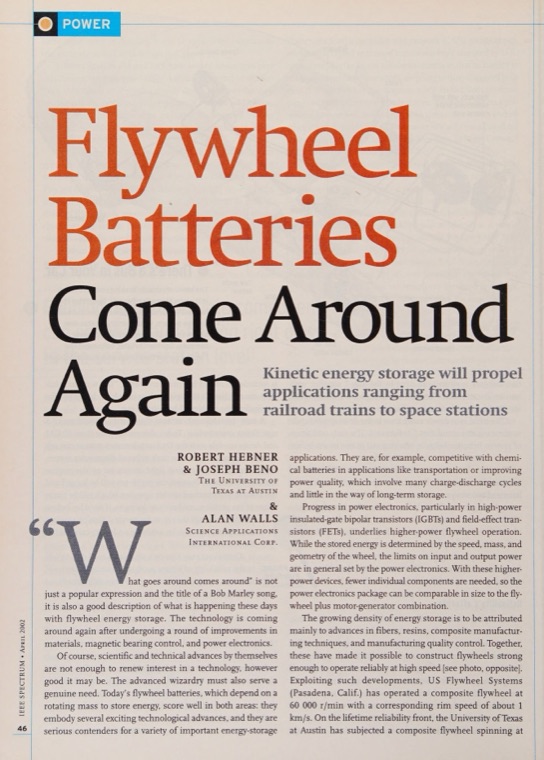
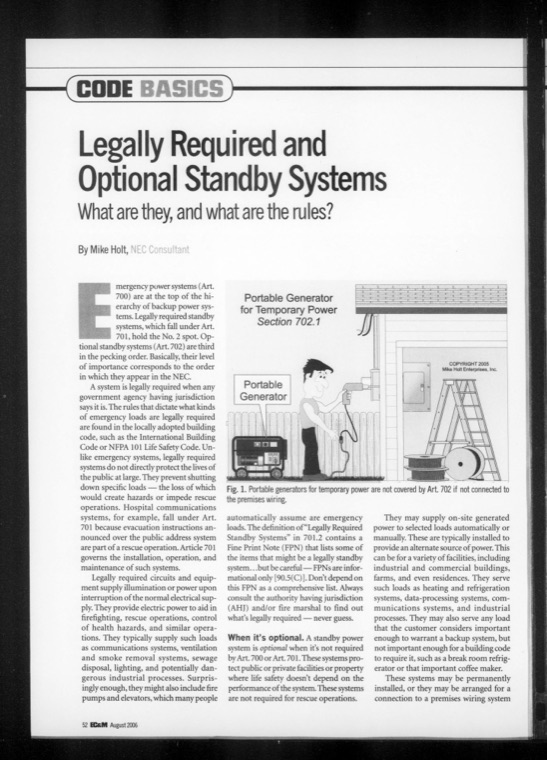
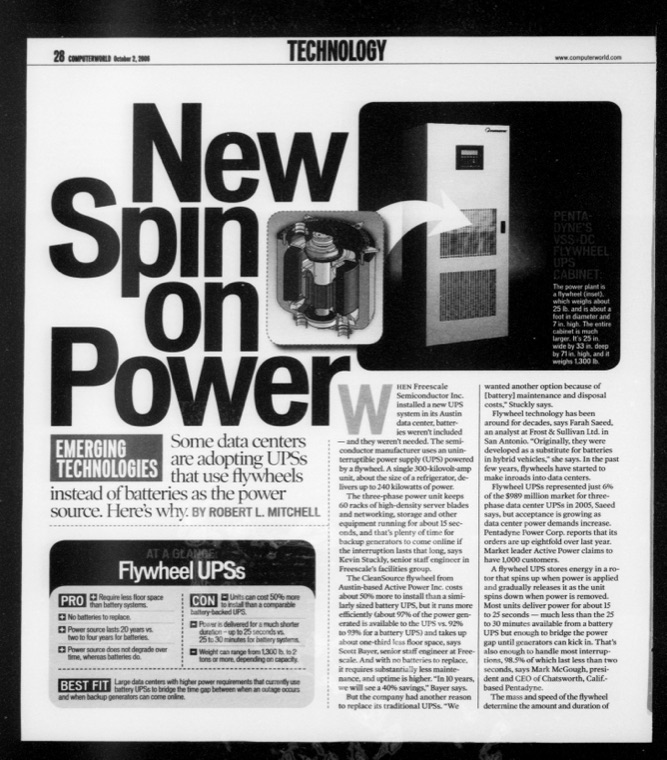
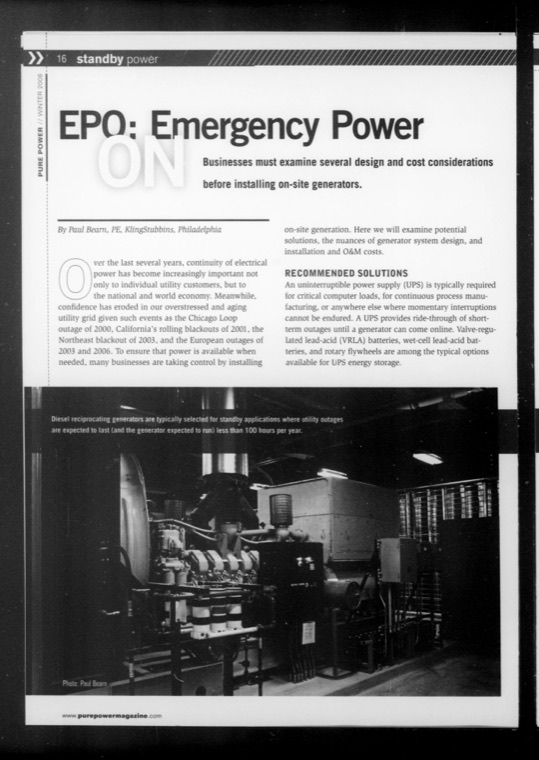
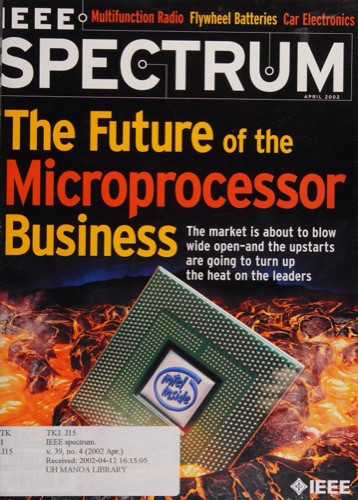
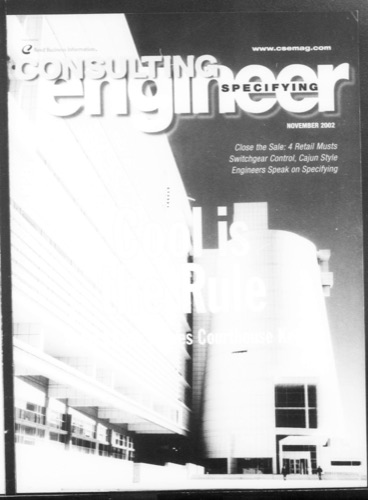
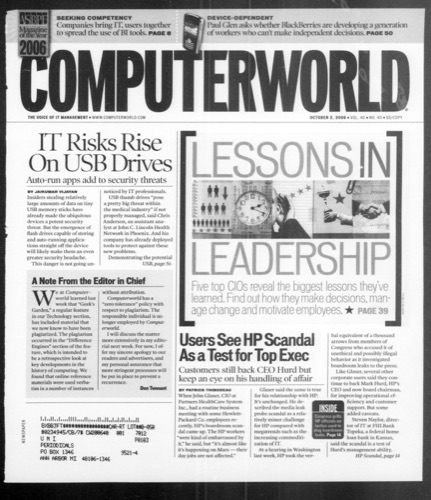
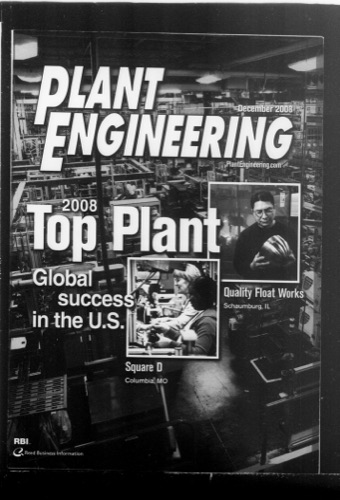
Brill, “Keeping Up Your UPS” — Datamation, Jul 1987Nacke — Power Engineering, Aug 2001Koch, “Centralized Backup Power” — CSE, Apr 2002Walter — CSE, Nov 2002: the battery-string MTBF case“Flywheel Batteries Come Around Again” — IEEE Spectrum, Apr 2002Holt — EC&M, Aug 2006: NEC 700/701/702Mitchell, “New Spin on Power” — Computerworld, Oct 2006Bearn, “EPO: Emergency Power” — Plant Engineering, Dec 2008
Eight of the 59 articles read in full. Click any page to open it in the scanned issue.
§1The question, and where we looked
A datacenter’s backup power is two machines: a standby generator set that carries the load for the hours of an outage, and a ride-through stage — traditionally a room of lead-acid batteries — that carries the ten-or-so seconds until the generator’s breaker closes. Designing one today (400 kW / 500 kVA, natural-gas, emergency-backup-only) raises the same three questions engineers argued about for decades: flywheel or battery for the bridge? Gas or diesel for the engine? And how do the pieces actually behave together?
It turns out our own shelves hold the argument in full. The Internet Archive’s serial collections include the runs of Consulting-Specifying Engineer (1987–2014), EC&M (1920–2014), Plant Engineering (1947–2013), Power Engineering (1902–2013), IEEE Spectrum (to 2018), and Datamation, Computerworld, and Network World for the computer-room operator’s view back to 1955. Four parallel readers OCR-searched every held issue (or a stated sample) of these nine titles, sorted the advertising from the bylined features, and read the substantive articles. Every citation below links to the exact page of the scanned issue.
§2Flywheel vs. battery: how the argument actually ran
1986–1997: batteries by default, minutes by habit. The mid-80s buyer’s guides treated 15–30 minutes of lead-acid reserve as normal, with diesel for anything longer (Datamation, July 1986). Kenneth Brill — who later founded the Uptime Institute — was already insisting in 1987 that the UPS is “just one element” of eleven subsystems, any of which can crash the computer (Datamation, July 1987). Flywheels appear only as one bullet in the 1997 configuration taxonomies (Consulting-Specifying Engineer, Fall 1997).
1999–2003: the case against the battery string. The quantitative attack came from the flywheel vendors, but the numbers were never rebutted: a 480-volt UPS battery is roughly 240 cells in series; sealed (VRLA) cells fail open-circuit, so a single cell kills the whole string. Measured failure curves — 2% of cells in year one, 4% in year two, ~20% in year three, ~35% in year four — put best-case battery-system MTBF near 2,100 hours, against a claimed 110,000+ hours for a flywheel (CSE, Nov. 2002). Ten years of battery replacements on a 1,000-kVA UPS: about $250,000 (EC&M, Oct. 2003). And the start-battery bonus: “The Achilles’ heel of standby generator systems is the battery. By using a flywheel UPS to start your generator, you eliminate the cause of most generator system failures” (EC&M, March 2001).
2004–2009: the consultants push back. The independent voices conceded VRLA’s fragility (life halves for every 10–15°F above 77°F; over 90% of installed UPS below 500 kVA ride on it) but scored the flywheel honestly: under one minute of reserve, bearing and seismic exposure, higher cost — and integrated flywheel UPS at 91–94% efficiency actually trails a good static UPS, where a 6% efficiency gap costs “$300,000 … for every 5-year operating period, for every 1,000 kW of load” (CSE, Spring 2004; CSE, Dec. 2009).
2006: convergence. A trade roundtable settled it: flywheels win “where fast-start generators are already installed” (CSE, March 2006). Since 98.5% of power disturbances last under two seconds and a generator starts in about ten, genset owners “are the first group to forge ahead without batteries” (EC&M, Feb. 2006). The best practice case is Freescale’s Austin datacenter: a 300-kVA flywheel “about the size of a refrigerator” carrying 60 racks ~15 seconds to generator start — 50% more to install than a battery UPS, 97% vs. 92–93% efficient, one-third the floor space, break-even at year six and 60% cheaper by year ten (Computerworld, Oct. 2006).
2011–2015: the argument leaves the building. The same fast-cycling physics moved to grid frequency regulation — 20-MW flywheel plants cycling fully 6,000+ times a year, “a battery really doesn’t like to be totally charged and discharged” — now in explicit competition with lithium-ion (IEEE Spectrum, July 2011; Jan. 2015). Stationary lithium-ion arrives in this literature only at its very end; the modern li-ion UPS post-dates the held runs.
§3Gas vs. diesel: the debate that mostly wasn’t
The striking negative finding: natural-gas-vs-diesel barely existed as a standby debate. Diesel was the unquestioned emergency default throughout — “at least 90 percent of back-up onsite generation units run on diesel” (Power Engineering, July 2002). Gas entered through side doors:
Siting and logistics. The recorded reasons engineers chose gas standby are refreshingly practical. A 1997 Long Island facility put a packaged gas genset on the roof “since natural gas was readily available in the building” — no diesel storage aloft (EC&M, Nov. 1997). A plastics plant “decided against [diesel] due to the inconvenience of on-site fuel storage.” And Chicago’s gas-standby tradition traces to the 1960s riots, when “diesel fuel truck drivers refused to drive into the disturbed areas, so generator sets could not be refueled” (CSE, Nov. 2000).
Economics by the hour. The cleanest statement is a 2008 table (Plant Engineering, Dec. 2008): diesel installs at $700–1,500/kW and burns ~$0.28/kWh; gas installs at $900–2,000/kW (the engine needs about twice the displacement for the same rating) and burns ~$0.16/kWh. So: diesel for true emergency duty under ~100 hours a year; gas once expected hours climb toward 2,000. Bi-fuel conversion — $30–80/kW to run a diesel on 50–80% pipeline gas — stretches a tank of stored diesel to five times the emergency runtime (Plant Engineering, Aug. 2003). Diesel’s stored fuel is also its maintenance liability: fuel-quality testing, polishing, and wet-stacking exercise requirements (EC&M, Sept. 2010).
The emissions wedge. EPA’s 2005-era rules created the boundary that makes “emergency backup only” a design parameter: a stationary emergency engine stays at the prior emissions tier with no add-on controls and up to 100 hours a year of test running, while non-emergency duty triggers Tier-4-class hardware — and storm-avoidance running “potentially fall[s] outside the ‘emergency’ definition” (Plant Engineering, March 2010). Compliance evidence: a non-resettable hour meter and fuel-purchase records.
§4Where designs actually fail: the coordination engineering
The deepest literature is not about hardware choice at all; it is about the interactions.
A genset is a limited source, not a small utility. Voltage and frequency dip on every load step; electronic loads trip below 90% of nominal. Sequence the loads — biggest motor first, and “put the UPS system on last” (EC&M, Nov. 1996). Size for restart inrush at ~2.3× normal load, and “unless you know for sure the facility has a solid battery maintenance program, you must size for inrush as though you have no UPS” (EC&M, Nov. 1997).
The gas-engine/UPS trap. Load steps make a gas engine’s frequency wander, which cycles a line-interactive UPS onto battery over and over — “especially pronounced with natural-gas-powered gensets … This repetitive battery cycling can cause the battery to discharge completely.” The cure is a double-conversion UPS (or a flywheel), which also permits sizing the genset at just 1.25–1.5× the protected load (Power Engineering, Aug. 2001).
Don’t oversize the engine. A diesel run below ~30% of its standby rating plugs injectors and “may even affect the system’s ability to carry loads when a real emergency occurs” (EC&M, Nov. 1996) — an argument for right-sizing, not padding.
The number for the flywheel-risk calculus: the IEEE Gold Book’s standby-generator fail-to-start rate is about 1.35 per 100 starts (Plant Engineering, Winter 2003). That is the probability a 15–30-second flywheel window closes on a dead bus — and the argument for programmed multi-crank retry, flywheel-assisted starting, or a few minutes of battery.
Transfer gear can subtract what the genset added. Molded-case throwover switches fail at three times the rate of drawout breakers; ground-fault protection with a genset requires switched-neutral (4-pole) transfer or the protection desensitizes (EC&M, March 2007). And “system redundancy will always be superior to component redundancy” (CSE, Winter 2000).
Classification, cleanly: NEC Article 700 emergency systems must have power in 10 seconds; Article 701 legally-required systems in 60; Article 702 optional standby — “systems [that] don’t protect people — they protect against financial loss” — is the datacenter case, and carries the fewest constraints (EC&M, Aug. 2006). NFPA 110’s real-world lesson: generators get exercised unloaded because nobody wants to flip building transfer switches — “a Code violation” — so design in a load-bank connection (EC&M, Sept. 2010).
§5What it means for a 400 kW gas plant — and what the record can’t say
Read against the design that prompted the exercise, the record is remarkably directive. The architecture — gas genset plus flywheel ride-through — is the literature’s own endpoint for sites with on-site generation, and 400 kW sits well above the ~150-kVA flywheel break-even the practitioners reported. Use a double-conversion or flywheel front end, never line-interactive (doubly important with a gas engine), and size the genset close. Cover the 1.35% fail-to-start case with multi-crank retry, flywheel-assisted starting, or a small battery for minutes of margin. Guard the emergency-only classification — no peak-shaving, no storm-avoidance running, keep the hour-meter logs — because the permitting and hardware savings are the quid pro quo for never running it economically. And design the testing in from day one; a gas plant’s reward is that there is no stored-fuel quality program at all.
What the shelves cannot say: the held runs end 2013–2015, before stationary lithium-ion matured, so the current li-ion-vs-flywheel price comparison has to come from vendors, not from this corpus. And the strongest flywheel numbers are vendor-authored (Active Power, APC, Liebert, Cummins); the independent consultants — Shapiro, DeCoster, Koch, Bearn, VanDyne, Holt — are consistently more conservative, and reading both sides is the point.
Forty years of trade magazines, read in an afternoon, turned a vendor-quote exercise into a design review conducted by the people who argued it out the first time. That is what a library of periodicals is for.
§6From the shelves: the issues
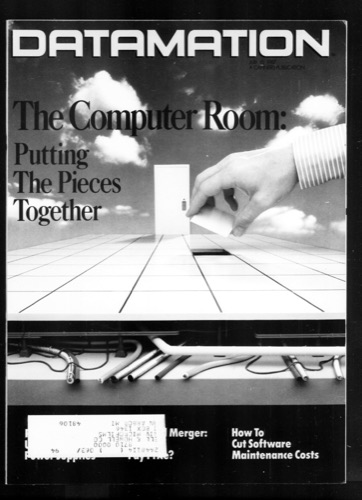
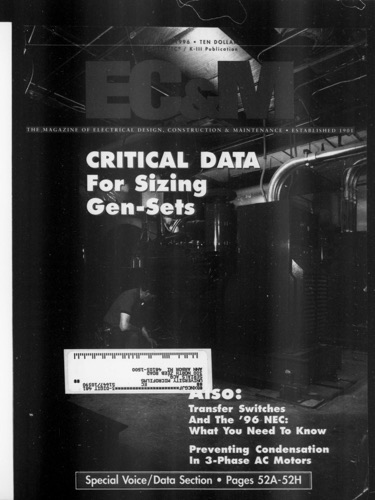
Datamation, Jul 1987: “The Computer Room”EC&M, Nov 1996: sizing gen-setsIEEE Spectrum, Apr 2002: “Flywheel Batteries” on the mastheadConsulting-Specifying Engineer, Nov 2002Computerworld, Oct 2006: the Freescale flywheel casePlant Engineering, Dec 2008: “Emergency Power”
Six of the ~1,950 issues read, from the Internet Archive’s serial collections. Click any cover to open the issue.
Method: four parallel Claude readers swept the held runs — Consulting-Specifying Engineer exhaustively (248 issues, 1996–2012), Plant Engineering + Power Engineering exhaustively (508 issues, 1993–2012), EC&M (216 issues, 1995–2012), and sampled IEEE Spectrum, Datamation, Computerworld, and Network World (~980 issues) — by per-issue OCR search, triaged ~2,700 keyword hits against advertising, and read 59 feature articles in full. Prices are as printed in their era, not inflation-adjusted. All page links go to the scanned issues in the Internet Archive’s serial collections.
Posted inUncategorized|Comments Off on Flywheels, Batteries, and Standby Generators: What 40 Years of Trade Magazines Say About Backing Up a Datacenter
Research report · Internet Archive holdings · 26 July 2026
Short answer: the memex itself was never built — not even a lab prototype. But Bush spent a decade building and funding its component machines, two of which were real, and one of which was delivered to the U.S. Navy. This report traces exactly how far each piece got, from sources in the Internet Archive’s own scanned collections.
§1What the memex was, and where it was only ever ink
Bush described the memex publicly just once during its era: “As We May Think,” in the Atlantic Monthly, July 1945 (vol. 176, no. 1, pp. 101–108) — a microfilm desk with two screens, a camera in the user’s hat-band, dry photography, and, at its heart, associative “trails” linking any two items. Two months later Life (Sept. 10, 1945, pp. 112–124) ran the condensed, illustrated version, with Alfred Crimi’s now-famous cutaway drawing of the memex desk. Life’s editors added the telling caveat that the machine was not yet in existence — a contemporary confirmation that in 1945 there was no hardware behind the essay.
The essay was not a sudden vision: a near-complete draft (“Mechanization and the Record”) circulated in 1939, and the concept traces to Bush’s MIT memos of the early 1930s. The drafts, and the two later memex essays, are collected in Nyce & Kahn’s From Memex to Hypertext (1991).
§2The machines he actually built
The Comparator (1937–38). Bush’s first information machine was built not for libraries but for Navy cryptanalysis (OP-20-G): a microfilm-and-photocell device to compare message tapes at high speed. It was delivered — and it failed. Colin Burke’s archival history records that when the components finally reached Washington they did not fit together, and reliability problems (film shrinkage, counters, optics) dogged it into storage. Burke’s verdict is that the Comparator’s failure shadowed Bush’s later information-machine efforts.
The Rapid Selector (1938–40). This is the closest the memex ever came to existence: a working MIT prototype that spun reels of 35 mm microfilm past a photoelectric reader, matching binary dot-codes beside each frame and flash-copying the hits — memex’s storage, coding, and retrieval mechanics, minus the trails. It was industrially sponsored (National Cash Register and Eastman Kodak money, on the order of $10,000-scale allocations Burke documents), engineered largely by Bush’s graduate students, and demonstrated. It never became a product, and war work ended it.
The descendants (1949–1950s). After the war Ralph Shaw, librarian of the U.S. Department of Agriculture, demonstrated a rebuilt Rapid Selector (engineered by Engineering Research Associates); intelligence agencies pursued their own — G. Pascal Zachary notes a 1950s NSA machine that was “really an elaborate version of the crude ‘rapid selector'” of the late 1930s. In practice the selectors were slow, fussy, and out-engineered by emerging digital methods; Burke quotes the 1950s judgment that “the fabled Bush Rapid Selector proved unworkable.” His book’s own machine inventory lists memex flatly as “machine never built.”
§3The late paper revisions
Bush redesigned the memex twice more — on paper. “Memex II” was drafted at his home in Belmont, Massachusetts after his 1955 retirement (manuscripts of 1958–59), swapping microfilm for magnetic storage and adding trails that strengthen with use; it went unpublished until Nyce & Kahn printed it in 1991. “Memex Revisited” (in Science Is Not Enough, 1967, at pp. 75 ff.) conceded that the enabling technology had finally arrived — and that the machine still had not been built. His memoir Pieces of the Action (1970) closes the record: Bush died in 1974 with the memex unrealized.
§4The verdict, stage by stage
Idea · reached 1932–39Mechanized-library memos at MIT; the 1939 draft essay.
Published design · reached 1945“As We May Think” (Atlantic; Life illustrated reprint). The memex never advanced past this stage as a whole machine.
Funded prototype · components onlyRapid Selector at MIT (1938–40): microfilm store + coded search + photo-copying output, working in the lab. No trails.
Delivered system · components onlyComparator, delivered to Navy OP-20-G (1938) — arrived broken, worked marginally, shelved. Postwar selectors (Shaw/ERA 1949, NSA versions) ran but disappointed.
Memex assembled · neverNo memex prototype was ever attempted, by Bush or anyone under him. The defining feature — associative trails — was never mechanized in his lifetime; it waited for digital hypertext (Engelbart and Nelson both credited the 1945 essay).
Why it stalled, per Burke and Buckland: Bush stayed committed to analog microfilm and photo-optics as computing went digital; dry photography and film handling never met the essay’s performance claims; and the memex’s social premise (a personal machine) had no sponsor in a decade of military patrons. Buckland adds the prior-art point: Emanuel Goldberg at Zeiss Ikon had patented and built a microfilm “statistical machine” by 1931 — so even the selector’s core mechanism was not, strictly, first.
§5Was it copyright that stopped him?
No — but the question has a real answer one movement over. In Burke’s archival history, copyright never appears as an obstacle to Bush’s machines: the Comparator failed on engineering, the Selector on reliability, funding, war priorities, and Bush’s analog commitments — and the only “infringement” in the record is patent infringement searching on the Selector (in the Honeywell v. Sperry-Rand files). His machines processed scientific abstracts and Navy cipher traffic; no publisher was ever in the loop to object. The memex itself never got far enough for rights to matter.
The publisher fight belonged to Robert C. Binkley and the documentation movement — the people whose project was access to the copyrighted record itself. Monika Dommann’s media history of copyright traces Binkley’s arc: early-1930s confidence that microfilm would let him rewrite the old copyright regime around “free trade in ideas”; the narrow truce of the 1935 Gentlemen’s Agreement with the National Association of Book Publishers (single copies for scholars, in place of a loan — while reaffirming the publishers’ exclusive rights); publishers questioning the agreement’s legal validity after the NABP reorganized in 1938; and Binkley’s growing disillusionment with the negotiations as the decade closed — turning against Berne ratification and insisting the right to copy is not the right to publish. He died in 1940 at forty-two, before the rematch that eventually arrived as Williams & Wilkins and CONTU.
Two ironies from the Nyce & Kahn volume: the only publisher friction in the whole memex story was over the essay — reprint-permission wrangling with LIFE, after several magazines had rejected the piece — and copyright enters the memex lineage as a design parameter only with Ted Nelson, whose “As We Will Think” (reprinted there) budgets royalties to copyright holders into the imagined system. The tradition eventually engineered for copyright; it was never stopped by it.
§6Where to verify each claim in the Archive’s scans
Bush, Vannevar. “As We May Think” (condensed; illus. Alfred D. Crimi). Life 19, no. 11 (Sept. 10, 1945): 112–124. IA: sim_life_1945-09-10_19_11.
Burke, Colin. Information and Secrecy: Vannevar Bush, Ultra, and the Other Memex. Metuchen, N.J.: Scarecrow Press, 1994. IA: informationsecre0000burk. The standard archival history of the Comparator and Rapid Selector.
Nyce, James M., and Paul Kahn, eds. From Memex to Hypertext: Vannevar Bush and the Mind’s Machine. Boston: Academic Press, 1991. IA: frommemextohyper0000unse_b3u7. Reprints the 1939 draft, “Memex II” (first publication), and “Memex Revisited.”
Bush, Vannevar. “Memex Revisited.” In Science Is Not Enough. New York: Morrow, 1967. IA: scienceisnotenou0000bush_p9y8.
Bush, Vannevar. Pieces of the Action. New York: Morrow, 1970. IA: piecesofaction00bush.
Zachary, G. Pascal. Endless Frontier: Vannevar Bush, Engineer of the American Century. New York: Free Press, 1997. IA: endlessfrontierv00zach.
Buckland, Michael. “Emanuel Goldberg, Electronic Document Retrieval, and Vannevar Bush’s Memex.” Journal of the American Society for Information Science 43, no. 4 (1992): 284–294. Author’s copy at Berkeleyarchive ↗ (Wayback-preserved; JASIS vol. 43 is not in the Archive’s scanned run — checked).
Shaw, Ralph R. “The Rapid Selector.” Journal of Documentation 5, no. 3 (December 1949): 164–171. IA: the-rapid-selector-shaw-1949. The operator’s own account of the ERA-built machine; opens by crediting Goldberg’s 1931 patent and Bush’s electronic system.
Dommann, Monika. Authors and Apparatus: A Media History of Copyright. Ithaca: Cornell University Press, 2019. IA: authorsapparatus0000domm. Binkley, the documentalists, and the Gentlemen’s Agreement.
Gitelman, Lisa. Paper Knowledge: Toward a Media History of Documents. Durham: Duke University Press, 2014. IA: paperknowledge00gite.
Hirtle, Peter B. “Research, Libraries, and Fair Use: The Gentlemen’s Agreement of 1935.” Journal of the Copyright Society of the USA 53 (2006): 545–601. Cornell eCommonsarchive ↗.
“The Gentlemen’s Agreement and the Problem of Copyright.” Journal of Documentary Reproduction 2 (1939): 29 ff. Not on archive.org (IA holds only JDR vol. 3, 1940, as american-documentation_1940-*); the full run (vols. 1–5, 1938–1942) is full-view and CC-BY-NC-4.0 at HathiTrust record 000546380archive ↗, with per-issue scans in the ALA Institutional Repository.
Prepared from the Internet Archive’s scanned collections; leaf numbers (n##) are BookReader page indexes verified by OCR search on 26 July 2026. External URLs verified present in the Wayback Machine. Updated the same day: added §5 (the copyright question and Binkley), the Shaw 1949 paper (newly added to archive.org as the-rapid-selector-shaw-1949), and the JDR/HathiTrust sourcing. Report by Claude for Brewster Kahle.
Posted inUncategorized|Comments Off on How Far Did Vannevar Bush Get on the Memex?
Research report · Internet Archive holdings · 27 July 2026
Vannevar Bush built the machine and ignored the rights. Robert Binkley fought the rights and had no machine. Ted Nelson designed both into one system — and the world shipped something else. One arc, told from the Archive’s own shelves.
These three stories are usually told separately: Bush as the prophet of hypertext, Binkley as a footnote in copyright history, Nelson as the eccentric who named the link. Read together — and our collections now hold every key document — they are one continuous argument about how scholarship gets command of the record, with each man seizing the part of the problem the others let drop.
Thread one · the machine · 1931–1949Bush: retrieval without rights
The memex story is told in full in the companion report; what matters here is what Bush’s machines touched. The Comparator read Navy cipher traffic. The Rapid Selector’s demonstrations ran on scientific abstracts. The memex existed only in magazine pages. At no point did a Bush machine hold enough of anyone’s copyrighted literature for a publisher to notice — the rights problem never arose because the machine never got that far. In Burke’s archival history of the projects, the only “infringement” is patent infringement, and the closest thing to a publisher dispute is Bush’s agent negotiating reprint permission for the essay itself.
The machine thread has a human splice to the next thread: Ralph Shaw, librarian of the U.S. Department of Agriculture — the same library that ran the documentation movement’s article-copying service — who rebuilt Bush’s Selector after the war and described it in 1949 in a paper we added to the Archive this week (the-rapid-selector-shaw-1949). Its opening page performs the whole lineage: credit to Goldberg’s 1931 patent, credit to Bush’s electronic system, used with Bush’s permission “for the public good.”
Thread two · the law · 1935–1940Binkley: rights without a machine
Robert C. Binkley ran the Joint Committee on Materials for Research with the opposite obsession. His 1935 Yale Review essay “New Tools for Men of Letters” (we hold it: sim_yale-review_1935-03_24_3, from p. 519) imagined micro-copying democratizing scholarship — and he understood immediately that the obstacle wasn’t optics but law. Where Bush’s machines never met a publisher, Binkley spent the decade negotiating with them: the 1935 Gentlemen’s Agreement with the National Association of Book Publishers bought scholars the right to a single copy in place of a loan, at the price of reaffirming the publishers’ exclusive rights. Its text ran in the movement’s own journal — the Journal of Documentary Reproduction, vol. 2 (1939) — whose surviving digital volumes we mirrored into the Archive this week. By 1938 publishers were questioning the agreement’s validity; Dommann’s history (authorsapparatus0000domm) tracks Binkley’s growing disillusionment, his turn against Berne ratification, his insistence that the right to copy is not the right to publish. He died in 1940, at forty-two, mid-fight.
The two threads were braided by the participants themselves, in a title almost too good to be true: in 1947, Vernon D. Tate — MIT’s librarian, and a veteran editor of the documentation movement — published “From Binkley to Bush” in The American Archivist (10:3, pp. 249–257; we hold it: american-archivist_1947-07_10_3, from leaf n26). The movement understood its own succession: Binkley’s cultural program of access was being handed to Bush’s engineering program of retrieval.
The succession Tate named in 1947 took twenty-five more years to produce someone who accepted both inheritances at once.
Thread three · the link · 1960–1993Nelson: both problems in one design
The direct line from Bush to hypertext runs through documents we hold in one volume: Nyce & Kahn (frommemextohyper0000unse_b3u7) reprints Douglas Engelbart’s 1962 letter to Bush alongside Ted Nelson’s 1972 “As We Will Think” — the paper whose title announces itself as the memex’s heir. But Nelson’s real distinction in this arc is that he is the first machine-builder since Binkley’s death to treat the rights problem as part of the engineering. In Literary Machines (three editions on our shelves, e.g. literarymachines00nels) the Xanadu design makes everything published quotable by transclusion — and wires a royalty into the act itself, metered per byte, flowing automatically to the owner of whatever is quoted. It is the Gentlemen’s Agreement rebuilt as system architecture: universal copying, universally licensed, with the publisher’s consent obtained once, structurally, instead of letter by letter.
He was still arguing it at the dawn of the web. In the Archive’s WAIS-era files sit three Nelson papers from 1992–93 — “You Will, Oscar, You Will!: The Implications of Free Quotability and Transpublication” (01Kahle000829), “Publishing Contracts for a Point-and-Click Universe” (01Kahle000846), and “Xanadu Space, 1993” (01Kahle000838) — proposing, on the eve of the web’s takeoff, exactly the rights layer the web would ship without. That these papers survive in this collection at all is its own footnote to the arc: they were in the working files of the people building the next distribution system while Nelson was proposing the licensing for it.
CodaNone of them shipped — and that is the point
Bush’s memex was never built; its component machines worked just well enough to prove the analog path a dead end.
Nelson’s Xanadu never shipped at scale; the web took the link and left the royalty, so the machine finally arrived with the law still unresolved — which is why Binkley’s half of the problem is still being litigated in the era of Bush’s machine.
The dovetail, in one line: Bush built without asking; Binkley asked without building; Nelson designed the asking into the building; the world built without the design. Any library that scans and lends today is living in the space those three outcomes left open.
ApparatusSources — all verified in our collections
Tate, Vernon D. “From Binkley to Bush.” The American Archivist 10, no. 3 (July 1947): 249–257. IA: american-archivist_1947-07_10_3, leaves n26–n34.
Shaw, Ralph R. “The Rapid Selector.” Journal of Documentation 5, no. 3 (Dec. 1949): 164–171. IA: the-rapid-selector-shaw-1949 (added this week).
“The Gentlemen’s Agreement and the Problem of Copyright.” Journal of Documentary Reproduction 2 (1939): 29 ff. Vol. 2 pending (full-view CC at HathiTrustarchive ↗); JDR vols. 1 (part), 3, 4 on IA — five issues mirrored from the ALA repository this week (journal-of-documentary-reproduction_*).
Nyce, James M., and Paul Kahn, eds. From Memex to Hypertext (1991). IA: frommemextohyper0000unse_b3u7 — includes Engelbart’s 1962 letter to Bush and Nelson’s “As We Will Think” (1972), with its royalties-to-copyright-holders costing.
Nelson, Theodor Holm. Literary Machines, ed. 87.1. IA: literarymachines00nels (royalty/transclusion design at leaves n126–n131; editions 81 and 93.1 also held).
Nelson, Theodor Holm. “You Will, Oscar, You Will!” / “Publishing Contracts for a Point-and-Click Universe” / “Xanadu Space, 1993” (1992–93). IA: 01Kahle000829, 01Kahle000846, 01Kahle000838 (WAIS collection).
Leaf numbers (n##) are BookReader page indexes verified by OCR search, 26–27 July 2026. External URLs verified present in the Wayback Machine (fresh captures triggered for the HathiTrust and ALAIR pages that lacked them). Report by Claude for Brewster Kahle.
Posted inUncategorized|Comments Off on The Machine, the Law, and the Link: Bush, Binkley, Nelson
[written by claude.ai leveraging the new archive.org Supreme Court collection]
Eight years before Jack Valenti called the VCR a “Boston strangler,” America’s publishers told the Supreme Court that the office copier would extinguish the printed word. A field guide to the doom prophecies of Williams & Wilkins Co. v. United States (1973–75) — verbatim from the briefs.
“I say to you that the VCR is to the American film producer and the American public as the Boston strangler is to the woman home alone.”
— Jack Valenti, president, Motion Picture Association of America, testifying to the House Judiciary Committee, April 12, 1982
That line is famous because it was so wrong: within a few years, home video was the single biggest revenue source the film industry had ever known. But Valenti’s Boston strangler had an older cousin. Eight years earlier, in the first case to ask whether a library’s photocopying counted as fair use, the nation’s publishers and authors filed a wall of amicus briefs at the Supreme Court warning that the Xerox machine would destroy scholarly publishing, the free press, and the marketplace of ideas.
The case was Williams & Wilkins Co. v. United States. A Baltimore medical publisher sued the National Institutes of Health and the National Library of Medicine for making single photocopies of journal articles for researchers. The publisher lost — but barely: the U.S. Court of Claims held the copying to be fair use by a vote of 4–3 (1973), and the Supreme Court affirmed by an equally divided 4–4 Court (1975). Read today, the briefs on the losing side are a museum of incumbent-industry catastrophizing. Here are the exhibits.
The exhibits
Exhibit A — the photocopier is a printing press
“Xerography and other copying techniques have already turned every office mailroom into a publishing house.”
Quoting a 1966 Newsweek article literally titled “Good-by to Gutenberg,” the brief argued a Xerox is a “plateless printing press” — so a library’s single-copy service was really mass publishing. (American Society for Testing & Materials et al., amicus brief, 1974; counsel Robert B. Washburn.)
Exhibit B — the journals will simply die
“Periodicals and journals are neither immortal nor immune from the laws of economics… periodicals — e.g. LIFE, LOOK, Saturday [Evening] Post, etc. — were forced to terminate their existence… it is only a matter of time before the same fate overtakes some of these periodicals.”
If magazines that big could fold, the argument ran, photocopying would finish off the scientific and technical journals next. (The Authors League of America, amicus brief, 1974; counsel Irwin Karp.)
Exhibit C — one copy replaces all copies
“‘Sharing’ is a euphemism which in library terms means that by the systematic use of photocopies one published copy of a work can take the place of many.”
The core economic claim: every photocopy is a subscription that will never be sold. (Association of American Publishers & Association of American University Presses, amicus brief, 1974; counsel Charles H. Lieb.)
Exhibit D — a censorship apocalypse
“…the public may well be the loser… because government functionaries, rather than independent copyrightees, will determine what may or may not be published.”
Kill the independent journals, the brief warned, and government publications fill the vacuum — recasting a fair-use ruling as a First Amendment threat. (Magazine Publishers Association, amicus brief, 1974; counsel Alfred H. Wasserstrom.)
Exhibit E — the slippery slope to the end of publishing
“…it would not be difficult to foresee a time when but one copy of a poem or short story or even a novel need be published and be readily made available to all free of charge.”
If a science article, then why not a poem, a story, a whole novel — one copy for everyone, forever. (Associated Councils of the Arts, amicus brief, 1974; counsel Howard M. Squadron.)
Exhibit F — death of the marketplace of ideas
“It further will disrupt and be destructive of the economic relationships on which this nation’s distinctive competitive marketplace of ideas depends.”
The largest possible stakes, for the smallest possible act: one library, one copy, one researcher. (Information Industry Association, amicus brief, 1974; counsel Paul G. Zurkowski.)
The verdict of hindsight
Scholarly and scientific publishing did not collapse. It became one of the most profitable industries in the world — operating margins widely reported in the 30–40% range — and journal subscription prices exploded over the following decades, the library “serials crisis” that is the precise opposite of death-by-photocopier. The Government’s own brief had already pointed out, in real time, that the plaintiff’s own subscriptions were rising: Medicine went from 2,864 to 5,444 over the decade at issue, and Gastroenterology from 4,132 to 7,006.
The Xerox turned out to be a rounding error next to the pricing power the publishers themselves would later wield. “The Xerox will kill journals” aged about as well as “the VCR is the Boston strangler” — and for the same reason. Both were copying technologies an incumbent industry swore would destroy it; both industries proceeded to monetize the technology and thrive. The publishers even got the compensation mechanism they wanted: the Copyright Clearance Center, founded in 1978, turned photocopying into a licensing revenue stream.
The one they got right
To be fair, not every prophecy missed. The American Chemical Society’s brief looked past the copier entirely:
“…the printed journal may someday be obsolete to be replaced by instant around-the-world dissemination of information through video display tubes.”
— American Chemical Society, amicus brief, 1974
That one came true. It just wasn’t the office copier that did it — and when the network did arrive, it made the journals richer, not extinct. The lesson of the copying-machine panics isn’t that new technology is harmless. It’s that the industries most sure a machine will destroy them are usually the ones about to make a fortune from it.
Sources. All amicus quotations are transcribed from the digitized briefs in Williams & Wilkins Co. v. United States, 487 F.2d 1345 (Ct. Cl. 1973), aff’d by an equally divided Court, 420 U.S. 376 (1975) — Internet Archive item micro_IA40385001_1623 (U.S. Supreme Court records & briefs); OCR lightly corrected, bracketed text supplied. “Good-by to Gutenberg,” Newsweek, Jan. 24, 1966, pp. 85–88 (as quoted in the ASTM brief). Valenti testimony: Home Recording of Copyrighted Works, House Judiciary Subcommittee hearings, 97th Cong. (Apr. 12, 1982); the technology reached the Court in Sony Corp. of America v. Universal City Studios, 464 U.S. 417 (1984). Publishing margins / “serials crisis”: RELX/Elsevier reporting; see Stephen Buranyi, The Guardian, June 27, 2017. A full case guide (briefs, the 4–4 deadlock, counsel) is attached to the Internet Archive item as a PDF.
Posted inUncategorized|Comments Off on Good-by to Gutenberg? Nope—Shrill Publisher Cries about the Xerox Machine Were Wrong
I now see how it can be addictive: A mindblowing experience and feeling like I see the world a bit differently. A feeling of being super smart and powerful. Getting lured in with free samples then everything costs. How it grabs my attention when using it, and then when I am not using it, I yearn to get back in.
Is it productive to think of generative AI as a new drug?
I have been thinking of a project in the decentralized web arena and trying to find someone to hire or inspire to try it out. Then a former Archivist gave a workshop at the Internet Archive showing how Slack programmers use Claude Code and it seemed too good to be true. So I thought I would try it. I dove in with a $20/month Claude Code subscription and started making astounding progress in an hour or so. It came up with a plan and started to execute it; we swerved, changed, debugged. I soon ran out of tokens and I needed to pay for more, this time $100/month– ok, lets try it. Point 1: first bit is free, then the cost escalates.
It flattered me at every step– “Good idea” “That will make a much better UX experience” etc. I was super good at this, apparently. It said so. All the time.
For 3 years, I have used generative AI tools like ChatGPT and Google AI summeries for one-shot help on spreadsheet formulas, command lines, helpful research, occasional entertaining poems or pictures. But yesterday I thought I would take out Claude code to see if I could prototype a project I have been dreaming of: a simple downloadable self-hosted web server that could be used without any of the hassles and costs of domain name registration, https certificate registration, hosting costs. A web server for a decentralized world. It is a project that would take a full time person maybe a year to get right and propagated, and that person is hard to find and expensive. Someone called the project “Onion Press.” Could I vibe code it?
I am a computer programmer but out of date. This tool magically could configure all the newest packages, knew how to take suggestions really well and iterated and fixed its own bugs. It was like having an impossibly-fast programming guru right there, always smiling.
My mind was blown watching a machine that could take vague suggestions and render them in code– and fast! It is surreal to watch the machine go through iterations debugging the setup– reading logs from multiple components watching things have issues and taking corrective action. It knows much more about these components than I do, and acts successfully. Mindblowing. I am trying to understand the implications of such a new capability being out in the world.
I felt super powerful– maybe now I could make my dreams come true. I even asked chatGPT for a logo for the project with a brief description, and out popped a nifty logo and related icons. In seconds.
After yesterday’s binge, I have been thinking of improvements all day. I can not wait to get back to the keyboard. It all seems too good to be true. Longing for another session of feeling empowered. And when I could not get back in, I had a feeling of loss, like missing an imaginary friend:
My description here could be someone describing a first psychedelic drug experience, complete with an urge to tell people of my experience.
Then it occurred to me: Generative AI is a New Drug. And it doesn’t spill. Yet.
Posted inUncategorized|Comments Off on Generative AI is a New Drug: Report on My First ‘Trip’
[This essay was included in every Wide Area Information Servers (WAIS) distribution as a way to instruct server operators (later to be called webmasters) on how to deal with log files. Software distributions can be found https://archive.org/details/freeWAIS-sf-1.0
I am proud of this essay. It seems prescient -brewster]
Ethics of Digital Librarianship Brewster Kahle Thinking Machines February 1992
“As digital librarian, you should serve and protect each patron as if she is your only employer.”
As more of us become involved in serving information electronically to other users, we so-called “digital librarians” must become conscious of our ethical responsibilities to protect the privacy of our the users being served. Since computers are being used by many more people to find answers from diverse information sources, we librarians that operate these servers are coming exposed to the exact questions and interests of people we do not know. This information has power, a power that can be abused and thereby thwart the usefulness of the tools we promote. In this essay, I will use the Wide Area Information Server system as an example of a system of digital librarians to show what information is collected and used. With this example, I hope to illustrate some of the dangers and help list some of the rules of etiquette for this emerging class of information providers.
The Wide Area Information Server (WAIS) system is an electronic publishing system that allows end-users to ask questions of remote information sources. The system encourages people to ask questions in natural language so that the server system can try its best to find appropriate documents. Therefore the operator of the server can collect the questions, and importantly, collect what documents the users thought were worth looking at. This combines to portray exact interests of the users. While the identity of the user is not trivial to determine since only the machine that the query came from is accessible from the server logs, as personal computers become networked, the identity of the machine will approximate the identity of the user.
On the positive side, this means that the server operator (the “digital librarian”) can use that data to refine the database and the search techniques used in the system. On the negative side, this is exposing many remote operators to private information that may not be consciously given by the users.
This surrender of information is not new to librarians; and the responsibility is taken very seriously by the professionals in the field. Through training in library schools and by an intuitive sense of ethics, reference librarians do not betray their patron’s interests to others that are curious or devious. This ethical code is not coded in law as it is with psychiatrists, so these records can be extracted through subpoena, but this level of demand is usually required to pry the information from librarians. From the patron’s point of view, having a librarian know what she is interested in can be a great value because the librarian can help select and route useful information in the future.
The same type of information is available to the digital librarians of the WAIS system. I operate the directory of servers in the WAIS system, and as such, I know what users are requesting access to what type of servers. I know, for instance, every time Mitch Kapor uses the system, and what he asks for (he specifically allowed me to include his name here). At this point this is not a problem since few servers are of a personal nature yet, but as the system grows to include entertainment, employment, health and other servers, it is easy to imagine the types of information that will be accessible through operating such a server. Furthermore, I know when particular users are at their machines, and therefore know where they are and when.
The abuses possible with this information are often not as direct as other offenses, but should not be discounted. People will act differently if they think they are being watched. Most people will try not to look silly or ignorant in public, and therefore might be less willing to try something new, to learn about a subject that they know nothing about. If using a WAIS server feels like raising one’s hand in school, then people will craft their questions more carefully than if it felt more like browsing through a new book. Often people say “I have nothing to hide,” which may be true, but if a stranger approaches on the street and knows quite a bit of personal information, then the innocent will likely take that person more seriously than if a cold stranger approached. Even with nothing to hide, most people feel they should who knows what about them. The personal nature of information access makes distributing collected questions a bit unnerving.
The information collected by the digital librarians have some different characteristics from physical librarians which can make abuse easier and more widespread: more people can be served, these people are often in other organizations, and the digital librarians rarely have personal contact with these users. Therefore, the patrons seem further away and therefore less real as human beings. Since the computer networks that are being used with WAIS span the globe and span company boundaries, the information collected can be useful in knowing what is important to a distant, and possibly competitive group. The lack of human contact can lead to the decay in social relations as has been documented in studies of electronic mail where the language and nature of relations tend to be stripped of grace, etiquette, and often respect [cite Sherry Terkle]. This detached nature of electronic interaction might lead librarians to not respect their patrons’ interests where they would if they knew them personally.
On the other hand, the information collected from patrons can be very useful to the digital librarian to refine and enhance the server. An example of this is a reporter at a financial newspaper. She is in the business of collecting information from corporate contacts, finding the trends in that information, throwing out the proprietary details, and selling it back to that same population. If the reporter published too many details, then her contacts would not be forthcoming the next time, and if she sanitized the information to the point of uselessness, similarly, her contacts would not invest the time. Therefore, it is precisely the interaction with the users that builds the information that is sold. This example shows another facet, and that is value that the contacts invest in the reporter for their own benefit. The digital librarian is a less extreme case, but still she is being invested and entrusted with what the users want, and if this information is misused or not used, then the users will not be as well served as could be. Thus, the users will want to be able to be served better by the librarian through feedback on services rendered.
While there are some technological mechanisms to obscure the identity of the patron, such as encryption and redirection, hopefully these will only be used in extreme cases. Encryption can be used to protect packets in transmission and also be used to sign packets so that they can not be forged [cite Whitfield Diffie]. This can be useful in a system where the transport media is insecure, such as radio transmission. Redirection is a server forwarding technique that would concentrate all the requests from one trusted host so that the individual requesters are more difficult to determine. Combinations of these techniques have been contemplated to provably obscure requesters while still providing accountability for charges, but hopefully these techniques will not be the norm if most server operators will act in good faith towards their patrons.
To try to list a code of ethics for this field is difficult since the technology keeps changing, but I will offer a principle that can be used to test a code. As digital librarian, you should serve and protect each patron as if she is your only employer. Therefore each patron should be served and protected individually. In terms of WAIS, I feel it is safe to suggest:
Don’t give away user logs except for scholarly use. Consider sanitizing the records before any transfer is undertaken.
Take the job of information serving seriously. This means to provide a consistent, reliable service and represent the service provided accurately.
Count on wide use of the information served, for good uses and bad, so be proud of the information and the collection.
Completeness is important. Users learn as much from a question that has no answer as from the ones with answers. This requires a complete and up-to-date collection.
Assume that the patron will not know the your affiliations, and therefore do not tempt patrons to use a service they would regret if they new more about you.
Respect your patrons. The opinion that users are “rocks with arms”, as said by a colleague years ago, will not lead you to become a very helpful digital librarian.
In conclusion, the rewards from being a digital librarian are numerous and can be evident from notes from users from remote countries and companies. This electronic publishing revolution allows anyone with a personal computer and a modem to be a publisher will have far reaching effects on the structure of our society. Being a good digital librarian is a concrete way to create a future we all want to live in.
Posted inUncategorized|Comments Off on Ethics Of Digital Librarianship (1992)