
Short answer: the engineering trade press litigated every element of the modern datacenter backup-power design between 1996 and 2010, and settled it — a standby generator plus a flywheel sized to the ~10 seconds the generator needs to start. We read ~1,950 issues of nine periodicals in the Internet Archive’s scanned collections (59 feature articles in full) while specifying a 400 kW natural-gas emergency plant, and this is what the record says.
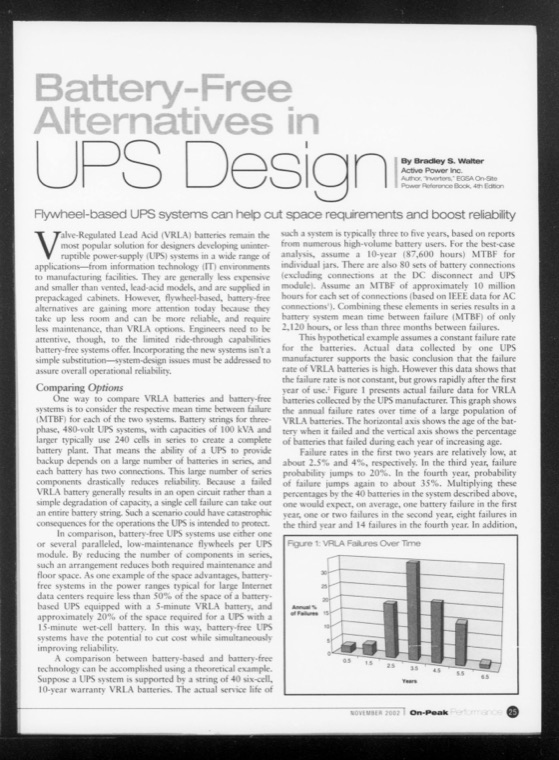
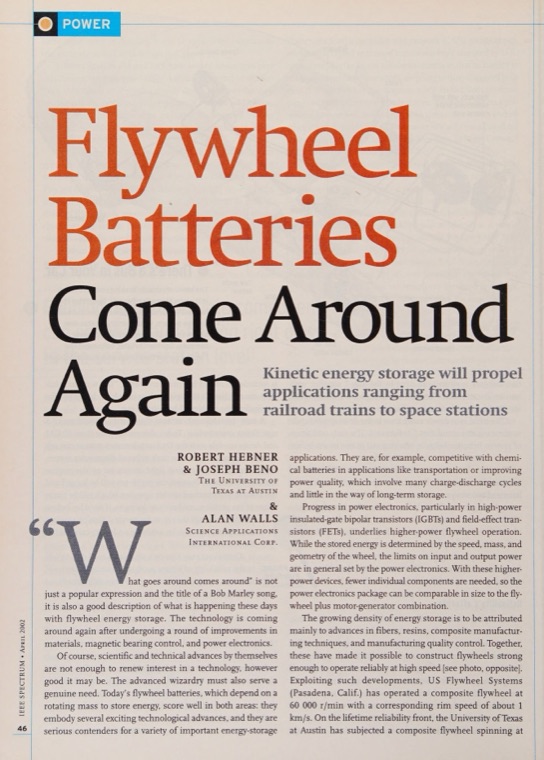
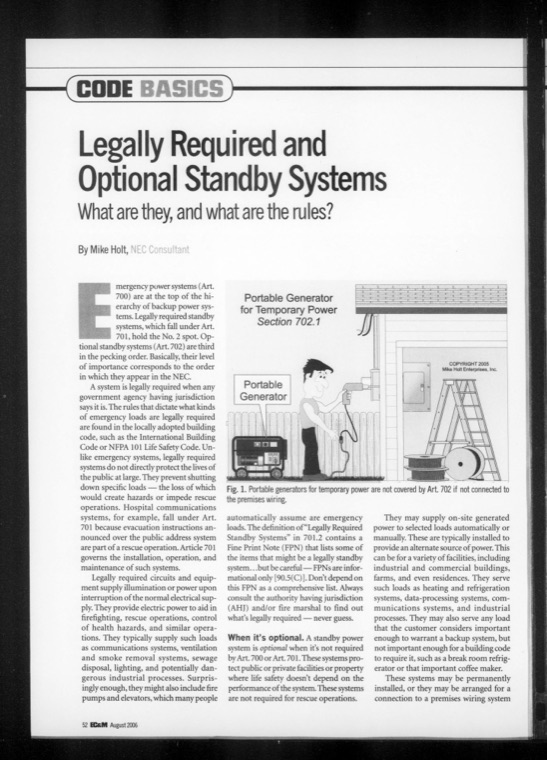
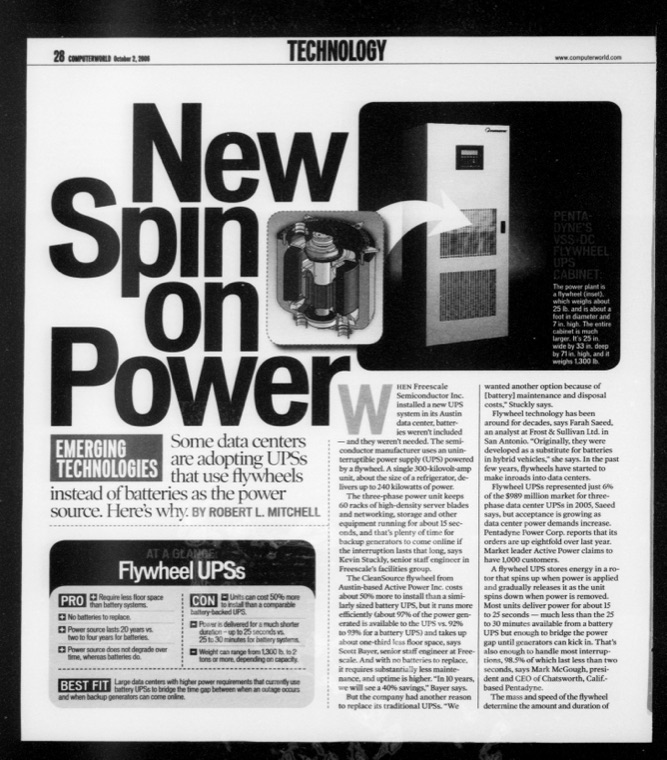
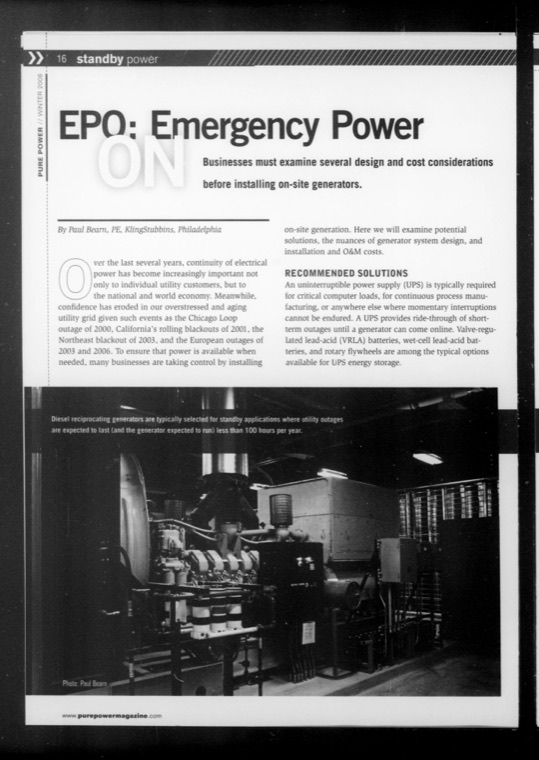
Eight of the 59 articles read in full. Click any page to open it in the scanned issue.
§1The question, and where we looked
A datacenter’s backup power is two machines: a standby generator set that carries the load for the hours of an outage, and a ride-through stage — traditionally a room of lead-acid batteries — that carries the ten-or-so seconds until the generator’s breaker closes. Designing one today (400 kW / 500 kVA, natural-gas, emergency-backup-only) raises the same three questions engineers argued about for decades: flywheel or battery for the bridge? Gas or diesel for the engine? And how do the pieces actually behave together?
It turns out our own shelves hold the argument in full. The Internet Archive’s serial collections include the runs of Consulting-Specifying Engineer (1987–2014), EC&M (1920–2014), Plant Engineering (1947–2013), Power Engineering (1902–2013), IEEE Spectrum (to 2018), and Datamation, Computerworld, and Network World for the computer-room operator’s view back to 1955. Four parallel readers OCR-searched every held issue (or a stated sample) of these nine titles, sorted the advertising from the bylined features, and read the substantive articles. Every citation below links to the exact page of the scanned issue.
§2Flywheel vs. battery: how the argument actually ran
1986–1997: batteries by default, minutes by habit. The mid-80s buyer’s guides treated 15–30 minutes of lead-acid reserve as normal, with diesel for anything longer (Datamation, July 1986). Kenneth Brill — who later founded the Uptime Institute — was already insisting in 1987 that the UPS is “just one element” of eleven subsystems, any of which can crash the computer (Datamation, July 1987). Flywheels appear only as one bullet in the 1997 configuration taxonomies (Consulting-Specifying Engineer, Fall 1997).
1999–2003: the case against the battery string. The quantitative attack came from the flywheel vendors, but the numbers were never rebutted: a 480-volt UPS battery is roughly 240 cells in series; sealed (VRLA) cells fail open-circuit, so a single cell kills the whole string. Measured failure curves — 2% of cells in year one, 4% in year two, ~20% in year three, ~35% in year four — put best-case battery-system MTBF near 2,100 hours, against a claimed 110,000+ hours for a flywheel (CSE, Nov. 2002). Ten years of battery replacements on a 1,000-kVA UPS: about $250,000 (EC&M, Oct. 2003). And the start-battery bonus: “The Achilles’ heel of standby generator systems is the battery. By using a flywheel UPS to start your generator, you eliminate the cause of most generator system failures” (EC&M, March 2001).
2004–2009: the consultants push back. The independent voices conceded VRLA’s fragility (life halves for every 10–15°F above 77°F; over 90% of installed UPS below 500 kVA ride on it) but scored the flywheel honestly: under one minute of reserve, bearing and seismic exposure, higher cost — and integrated flywheel UPS at 91–94% efficiency actually trails a good static UPS, where a 6% efficiency gap costs “$300,000 … for every 5-year operating period, for every 1,000 kW of load” (CSE, Spring 2004; CSE, Dec. 2009).
2006: convergence. A trade roundtable settled it: flywheels win “where fast-start generators are already installed” (CSE, March 2006). Since 98.5% of power disturbances last under two seconds and a generator starts in about ten, genset owners “are the first group to forge ahead without batteries” (EC&M, Feb. 2006). The best practice case is Freescale’s Austin datacenter: a 300-kVA flywheel “about the size of a refrigerator” carrying 60 racks ~15 seconds to generator start — 50% more to install than a battery UPS, 97% vs. 92–93% efficient, one-third the floor space, break-even at year six and 60% cheaper by year ten (Computerworld, Oct. 2006).
2011–2015: the argument leaves the building. The same fast-cycling physics moved to grid frequency regulation — 20-MW flywheel plants cycling fully 6,000+ times a year, “a battery really doesn’t like to be totally charged and discharged” — now in explicit competition with lithium-ion (IEEE Spectrum, July 2011; Jan. 2015). Stationary lithium-ion arrives in this literature only at its very end; the modern li-ion UPS post-dates the held runs.
§3Gas vs. diesel: the debate that mostly wasn’t
The striking negative finding: natural-gas-vs-diesel barely existed as a standby debate. Diesel was the unquestioned emergency default throughout — “at least 90 percent of back-up onsite generation units run on diesel” (Power Engineering, July 2002). Gas entered through side doors:
Siting and logistics. The recorded reasons engineers chose gas standby are refreshingly practical. A 1997 Long Island facility put a packaged gas genset on the roof “since natural gas was readily available in the building” — no diesel storage aloft (EC&M, Nov. 1997). A plastics plant “decided against [diesel] due to the inconvenience of on-site fuel storage.” And Chicago’s gas-standby tradition traces to the 1960s riots, when “diesel fuel truck drivers refused to drive into the disturbed areas, so generator sets could not be refueled” (CSE, Nov. 2000).
Economics by the hour. The cleanest statement is a 2008 table (Plant Engineering, Dec. 2008): diesel installs at $700–1,500/kW and burns ~$0.28/kWh; gas installs at $900–2,000/kW (the engine needs about twice the displacement for the same rating) and burns ~$0.16/kWh. So: diesel for true emergency duty under ~100 hours a year; gas once expected hours climb toward 2,000. Bi-fuel conversion — $30–80/kW to run a diesel on 50–80% pipeline gas — stretches a tank of stored diesel to five times the emergency runtime (Plant Engineering, Aug. 2003). Diesel’s stored fuel is also its maintenance liability: fuel-quality testing, polishing, and wet-stacking exercise requirements (EC&M, Sept. 2010).
The emissions wedge. EPA’s 2005-era rules created the boundary that makes “emergency backup only” a design parameter: a stationary emergency engine stays at the prior emissions tier with no add-on controls and up to 100 hours a year of test running, while non-emergency duty triggers Tier-4-class hardware — and storm-avoidance running “potentially fall[s] outside the ‘emergency’ definition” (Plant Engineering, March 2010). Compliance evidence: a non-resettable hour meter and fuel-purchase records.
§4Where designs actually fail: the coordination engineering
The deepest literature is not about hardware choice at all; it is about the interactions.
A genset is a limited source, not a small utility. Voltage and frequency dip on every load step; electronic loads trip below 90% of nominal. Sequence the loads — biggest motor first, and “put the UPS system on last” (EC&M, Nov. 1996). Size for restart inrush at ~2.3× normal load, and “unless you know for sure the facility has a solid battery maintenance program, you must size for inrush as though you have no UPS” (EC&M, Nov. 1997).
The gas-engine/UPS trap. Load steps make a gas engine’s frequency wander, which cycles a line-interactive UPS onto battery over and over — “especially pronounced with natural-gas-powered gensets … This repetitive battery cycling can cause the battery to discharge completely.” The cure is a double-conversion UPS (or a flywheel), which also permits sizing the genset at just 1.25–1.5× the protected load (Power Engineering, Aug. 2001).
Don’t oversize the engine. A diesel run below ~30% of its standby rating plugs injectors and “may even affect the system’s ability to carry loads when a real emergency occurs” (EC&M, Nov. 1996) — an argument for right-sizing, not padding.
The number for the flywheel-risk calculus: the IEEE Gold Book’s standby-generator fail-to-start rate is about 1.35 per 100 starts (Plant Engineering, Winter 2003). That is the probability a 15–30-second flywheel window closes on a dead bus — and the argument for programmed multi-crank retry, flywheel-assisted starting, or a few minutes of battery.
Transfer gear can subtract what the genset added. Molded-case throwover switches fail at three times the rate of drawout breakers; ground-fault protection with a genset requires switched-neutral (4-pole) transfer or the protection desensitizes (EC&M, March 2007). And “system redundancy will always be superior to component redundancy” (CSE, Winter 2000).
Classification, cleanly: NEC Article 700 emergency systems must have power in 10 seconds; Article 701 legally-required systems in 60; Article 702 optional standby — “systems [that] don’t protect people — they protect against financial loss” — is the datacenter case, and carries the fewest constraints (EC&M, Aug. 2006). NFPA 110’s real-world lesson: generators get exercised unloaded because nobody wants to flip building transfer switches — “a Code violation” — so design in a load-bank connection (EC&M, Sept. 2010).
§5What it means for a 400 kW gas plant — and what the record can’t say
Read against the design that prompted the exercise, the record is remarkably directive. The architecture — gas genset plus flywheel ride-through — is the literature’s own endpoint for sites with on-site generation, and 400 kW sits well above the ~150-kVA flywheel break-even the practitioners reported. Use a double-conversion or flywheel front end, never line-interactive (doubly important with a gas engine), and size the genset close. Cover the 1.35% fail-to-start case with multi-crank retry, flywheel-assisted starting, or a small battery for minutes of margin. Guard the emergency-only classification — no peak-shaving, no storm-avoidance running, keep the hour-meter logs — because the permitting and hardware savings are the quid pro quo for never running it economically. And design the testing in from day one; a gas plant’s reward is that there is no stored-fuel quality program at all.
What the shelves cannot say: the held runs end 2013–2015, before stationary lithium-ion matured, so the current li-ion-vs-flywheel price comparison has to come from vendors, not from this corpus. And the strongest flywheel numbers are vendor-authored (Active Power, APC, Liebert, Cummins); the independent consultants — Shapiro, DeCoster, Koch, Bearn, VanDyne, Holt — are consistently more conservative, and reading both sides is the point.
Forty years of trade magazines, read in an afternoon, turned a vendor-quote exercise into a design review conducted by the people who argued it out the first time. That is what a library of periodicals is for.
§6From the shelves: the issues




Six of the ~1,950 issues read, from the Internet Archive’s serial collections. Click any cover to open the issue.
Method: four parallel Claude readers swept the held runs — Consulting-Specifying Engineer exhaustively (248 issues, 1996–2012), Plant Engineering + Power Engineering exhaustively (508 issues, 1993–2012), EC&M (216 issues, 1995–2012), and sampled IEEE Spectrum, Datamation, Computerworld, and Network World (~980 issues) — by per-issue OCR search, triaged ~2,700 keyword hits against advertising, and read 59 feature articles in full. Prices are as printed in their era, not inflation-adjusted. All page links go to the scanned issues in the Internet Archive’s serial collections.
