For a century, the universities of Europe ran a remarkable system for copying and circulating dissertations they produced. Then the web arrived, and we quietly stopped. Here is that story — and pointing to how the Internet Archive Europe hopes to help.
(by Brewster Kahle and Claude)
Long before anyone spoke of open access, Europe’s universities had already solved the problem of sharing scholarship — with printing presses, shipping crates, and standing agreements between libraries.
The system was called, in German, the Dissertationentausch — the dissertation exchange. From the late nineteenth century well into the twentieth, a doctoral candidate at a German, Swiss, Dutch, or Scandinavian university could not simply hand in a typescript and collect a degree. The university required the dissertation to be printed in bulk — in Germany usually 150 or more copies (Joan Ash, “The Exchange of Academic Dissertations,” College & Research Libraries, May 1969, p. 237), deposited with the university library as a condition of graduation.
The library kept a few copies. The rest went into crates.
Through exchange offices — Tauschstellen — each university shipped its dissertations to partner universities across Europe and around the world, and received theirs in return. No money changed hands. A research library in Uppsala or Leiden or Chicago accumulated a nearly comprehensive collection of the doctoral output of dozens of other universities, year after year, without purchasing a single volume. In 1958, UNESCO formalized what the libraries had long practiced, with two international conventions on the exchange of publications.
The French chapter. France ran its own version: university theses were printed and exchanged from the 1880s onward, and in 1971 the system was modernized through the Atelier national de reproduction des thèses (ANRT) in Lille, which reproduced every French doctoral thesis on microfiche and circulated it to university libraries nationwide. In the United States, University Microfilms played a similar role on film.
What the exchange quietly achieved
The exchange was built for access — a scholar in one city could read the dissertations of another. But its greatest achievement was one nobody had to argue for: preservation through redundancy. Every thesis existed in dozens or hundreds of copies, scattered across libraries on several continents. Wars, fires, floods, and institutional collapse could destroy any one collection, and did — and the scholarship survived, because no single building held the only copy.
Librarians today have a slogan for this principle: lots of copies keep stuff safe. The dissertation exchange practiced it for a hundred years before anyone needed to say it out loud.
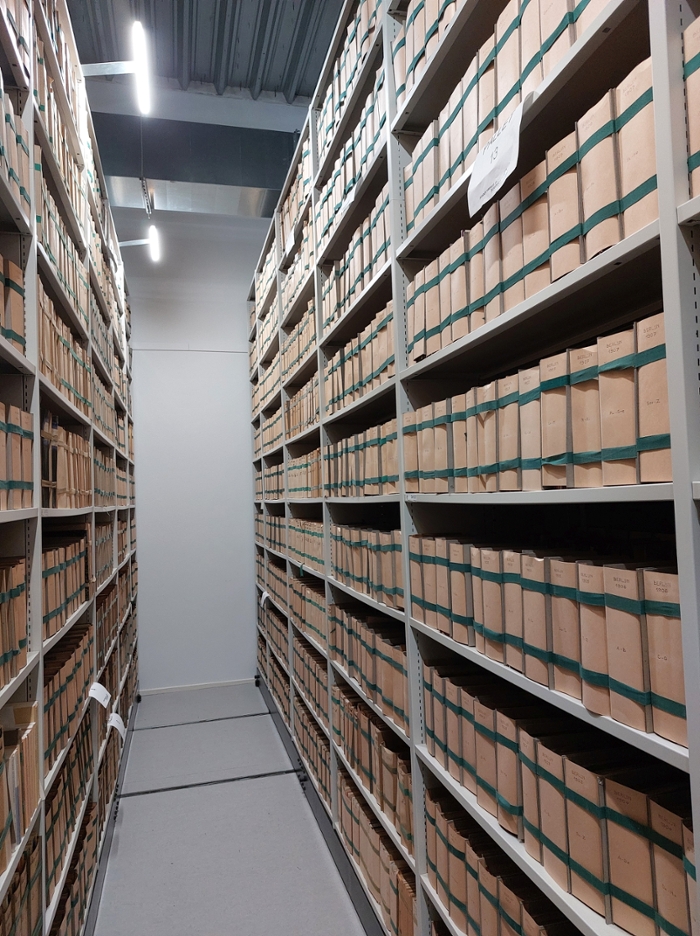
The scale of what accumulated is hard to overstate. The University of Leiden, a hub of the exchange for generations, built one of the world’s great collections of printed theses — so vast that many of them remain uncatalogued to this day: scholarship that was faithfully copied, shipped, and shelved, and is still waiting to be found. The library told the collection’s story in its 2005 exhibition catalog Hora est! On dissertations (archived) — “Hora est,” “it is time,” being the cry that ends every Leiden doctoral defense.
Then we stopped
Between the 1980s and the 2000s, the printing requirements were dropped, one country at a time. Microfiche came and went. Electronic deposit arrived, and it was a genuine advance: today a thesis goes into a university’s institutional repository, discoverable by anyone with a browser, at no cost to the student.
But look at what happened to the copies. Where the exchange put a hundred and fifty copies of each thesis in a hundred and fifty buildings, the digital thesis typically lives on one server, at one institution. If that repository is migrated carelessly, defunded, restructured, or attacked, the scholarship is simply gone — or dark for years. This is not hypothetical: EThOS, the British Library’s national e-theses service holding records of half a million UK doctorates, has been offline since a cyberattack in 2023. Links rot; repositories move; universities merge and close. We replaced the most redundant scholarly distribution system ever built with the least redundant one.
Rebuilding the exchange, at web scale
That is the gap the Internet Archive Europe is working to close. It started with a donation of a substantial collection from Leiden University. More on this in other posts.