
By Brewster Kahle and Claude
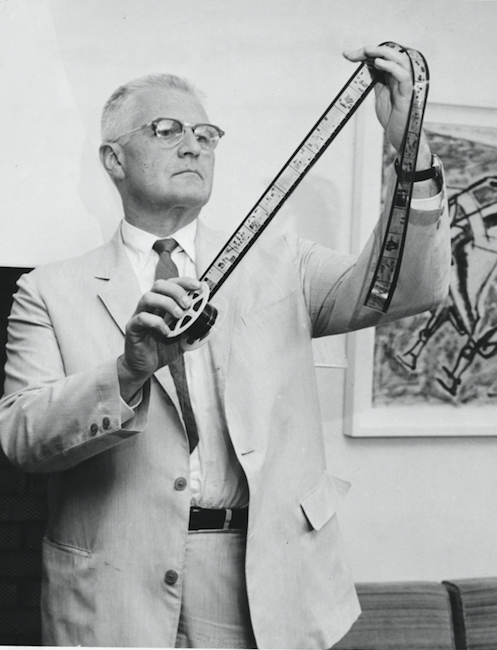
Europe circulated its theses by printing each one by the hundred. America’s answer was the opposite: one typescript, one camera, and a company in Ann Arbor that would make and sell a copy to anyone who asked — an edition of one.
In our last post we told the story of the great European dissertation exchange — every thesis printed in bulk and shipped to many libraries for fee access. America when in a more commercial direction. By the Second World War most American universities had stopped requiring graduate students to publish their dissertations in book form; a thesis was a typescript in the degree-granting library, available only on interlibrary loan. Even where publication fees survived — Michigan charged $75 “in lieu of publication” (Power, Edition of One, p. 89) — the printed theses that did circulate were sometimes difficult to locate and borrow.
The man who changed that was Eugene Power. He had spent his nights in 1936 in a rented darkroom behind Ray Dolph’s funeral parlor in Ann Arbor, filming rare English books for American libraries, and in June 1938 he left his job to found University Microfilms on an inversion of the economics of publishing: presses are efficient only in bulk, but with microfilm you film a work once and print a copy only when someone asks. A book could be published profitably in an edition of one — the title he later gave his autobiography. (Other visions for microfilm are fascinating involving Robert Binkley and Vannevar Bush, but this have to wait).
Dissertations were the perfect case for Power’s vision. One of his first acts was a pamphlet, A Plan for Publication of Scholarly Material by Microfilm: the university sends each dissertation to Ann Arbor; UMI films it and vaults the master negative; the abstract is printed in a catalog — Microfilm Abstracts, later Dissertation Abstracts — distributed free to two hundred of the world’s leading libraries; and any scholar who finds something promising orders a copy of the full text, made on demand — in those years a positive print of the film itself. Total cost to the student: $15, “less than the cost of typing it.” Where Europe shipped printed copies of the thesis itself, Power shipped two hundred copies of the abstract and copied the rest only when asked. Paper came two decades later: around 1957 Power watched a Xerox Copyflo enlarge microfilm onto a continuous paper web and realized the vault could print books — “At last I could truly publish a single copy of a work ‘on demand’ without compromise” (p. 229) — and dissertations could be ordered as bound, acid-free paper books printed from the master negative.
The wartime chapter. The war made the case for film. Power’s cameras kept running in the British Museum under a Rockefeller grant, rare books and manuscripts crossing the Atlantic as film to subscribing American libraries while London was bombed; at home UMI filmed eight million pages of ship manifests for the Justice Department and printed the tens of thousands of engineering drawings behind the P-51 fighter. Copies, again, as a hedge against catastrophe. (Power, Edition of One, pp. 139–142)
A decisive moment came on January 26, 1952, when the Association of Research Libraries, meeting in Iowa City, took up the report of Ralph Ellsworth’s committee on the publication of dissertations: that all doctoral dissertations be published, that micropublication was suitable, and that ARL members join an enlarged Microfilm Abstracts program. The costs were “sharply attacked” in discussion — and “a motion to adopt the report was carried” (“Brief of Minutes, Association of Research Libraries,” College & Research Libraries 13, no. 3, July 1952, p. 254). Ellsworth later recalled the mission as closing a “gap in the distribution of the literature of scholarship,” with the film negatives “considered as the archival copy” kept in UMI’s vaults (Ellsworth, quoted in Power, pp. 165–166). Graduate schools across the country signed on. By the time Power wrote his memoir in 1990, UMI was publishing 98 percent of all dissertations accepted by American institutions each year.
Xerox announced its acquisition of University Microfilms on February 20, 1962 — an exchange of stock the trade press valued at almost $7.9 million — with Power staying on to run it as a wholly-owned subsidiary — until 1970, eight years later, when a new Xerox mandatory-retirement policy forced him out at sixty-five, over his objections (Power, pp. 317–318) (“Xerox Corporation Acquires University Microfilms, Inc.,” Publishers’ Weekly, March 5, 1962, p. 36). Xerox’s longtime research chief John Dessauer remembered it the same way in his own memoir — “The acquisition of University Microfilms was completed in 1962” — and quotes the report to Xerox shareholders: 85 percent of all American doctoral dissertations were by then being filmed through arrangements with 135 universities, with over sixty-two thousand dissertations on file (Dessauer, My Years with Xerox, pp. 166–167); the operation later passed to Bell & Howell and became today’s ProQuest, whose dissertation database — the direct descendant of Power’s vault — holds several million theses and remains, for much of 20th-century American scholarship, the only copy outside the degree-granting university.
Set the two systems side by side and you can see what each traded away. Europe’s exchange put a hundred and fifty copies in a hundred and fifty buildings (Joan Ash, “The Exchange of Academic Dissertations,” College & Research Libraries, May 1969, p. 239) — magnificent redundancy, but no central catalog and, as Leiden’s uncatalogued stacks remind us, no guarantee anyone could find a given thesis. America’s microfilm put every thesis in one catalog, findable and orderable — but the masters sat in a single corporate vault, and access ran through a single company, as it still does.
Findable and safe
The lesson of the 20th century is that circulation needs both: many copies, and one catalog. That is what the program at the Internet Archive Europe is starting to build for the world’s theses. More on this in other posts.