Debt-Free Housing for Public-Benefit Workers

Brewster Kahle
January 9, 2012
On archive.org.

The largest single expense for the staff of the Internet Archive is housing, as this paper will show the majority of the cost of housing goes to debt service (either directly through mortgage, or indirectly through rent).    If employees could live in debt-free housing, then their expenses would go down and sense of security could go up.   This paper explains why this might be a good idea not only for the Internet Archive employees, but for all workers in public-benefit non-profit organizations and goes on to suggest how to start a system of debt-free housing.

Some say they are in a “Debt Trap”, and indeed they are– a cycle where debt piles on debt and becomes difficult to escape.  The average household debt in just credit cards is over $15k and the average interest charged on this debt is over 13% per year[1].   Debt payments absorb between 11% and 24% of people’s incomes, depending on what is counted.[2]  But if we pull back, there is a game, a “Debt Game” if you will, that has winners and losers.   A well-designed game makes the winners think they deserve to win, and the losers feel that if they just try again they might just win.   But it is important to know it is a game, because games have rules.    These rules are made up, they are an invention, and so, in theory, they can be changed.   Some people have become successful by expanding the Debt Game by creating new opportunities for people to get into debt: what was mainly debt from houses and farms then moved to car loans, then credit card debt and now student loans are propagating on an industrial scale.   As some product or service type comes to be bought using debt by the majority of people it becomes more difficult to buy these things without debt because prices, terms, and regulations start to assume participation.   But participation in this game is not always mandatory– there may be alternatives if we plan carefully.    This paper will explore how we can opt out of some of the Debt Game by establishing enduring and transferable debt-free housing.  Given that housing is the largest fraction of family debt, this could be a significant achievement, and one that could lead to further steps towards living debt-free.

Lets spend just a minute more on the debt game. The NY Times reported that the median family net worth (total assets minus total debts) the US is $70k and falling.[3]   If we were to take away the house price support supplied by the Federal government through mortgage guarantees or federal mortgage purchase programs then we could find that already more than ½ of all households in the United States having a negative net worth, in other words, owe more than they own.   Living in debt can increase family stress and psychological issues.  Thus having ½ of all households having an effective negative net worth seems like a poor societal policy.   But this might not be surprising if one considers where both money and debt come from:  they are created from each other—when money is created, debt is created and when debt is paid off, money disappears.   Many people do not realize this characteristic of money and debt, but it is important if we are to understand the nature of the Debt Game.    With modern money, like the dollar, 95% of all money is created when banks make loans such as a mortgage.  Here is how it works.   A bank has to keep a small percentage of their deposits “in the bank” as a reserve, the rest can be lent.   A bank customer who takes out a mortgage gets money to buy the house and a contract to pay it back over time.    The money goes to the seller who then puts most of that money back into another bank.  That bank has to keep the small fraction of their deposits on hand (historically 5%), and then can lend out the rest.   But because most of the money they lend out gets redeposited into a bank somewhere, most of that money can be lent out again, thus for every 1 dollar originally created by the treasury through the federal reserve system, another 19 dollars in both debt and money can be created.  This is called the fractional reserve system, and the more money there is the more debt there is as well, and vice versa.   Since individuals or corporations can accumulate money without limit, and because households, in practice, are only allowed so much debt before they may not borrow any more, the number of debtors will tend to be more than creditors.    Therefore the Debt Game has more losers than winners[4].   I mention this because it may inspire interest in alternatives, at least for life’s essentials such as food, housing, education, and health.    This debt has real implications in people’s lives, and therefore could warrant our attention to create as positive a system as we can.

In a survey of the employees of the Internet Archive, housing turned out to be the largest expense for our employees (appendix A).   For those that scan books in San Francisco for about two thousand five hundred dollars a month, they pay about half, or $1250, of their monthly gross income in rent.   The programmers and head administrative staff are paid about three to ten thousand per month and rent or mortgage was often consumes 30% to 50% of their gross incomes.     This is not restricted to just the high cost of housing in San Francisco.   A 2011 Harvard study found that 49% of all renters paid above 30% of their income in rent[5].  For those in the income category of our scanners[6],  88% pay over 30% of their income, and 63% of them pay more than half of their income in rent.    Say that again: 63% pay more than half of their income in rent, a level that is called “severely burdened” by the census department.

The same study showed that rents are increasing faster than incomes since 1980, which can bring a level of insecurity to an employee.   Therefore, if we can find a way to decrease this expense and increase its price stability, then the employees might feel more secure and be able to accept the lower salary that often comes with non-profit work.

Those that own houses face the same issues, especially those on the coasts.   Nationwide owners, including those without mortgages, 18% of them pay over 30% of their income for housing in 2007, and for those in the income category of our scanners, over 65% pay over 30% of their income[7].  And Californians pay a higher percentage than average Americans.

Housing cost, then, is a large burden on all workers, not just public benefit workers.   But public-benefit workers have a special role in society, which should take extra care in protecting.

From a societal perspective, the time we most need public benefit workers is in recessions.   Unfortunately many of the funding sources for public benefit organizations go through the same cycles as for-profit organizations but somewhat indirectly through taxes and philanthropies, which in turn are subject to the same business and investment cycles.    If we can build a system that brings expense stability through down cycles for public benefit workers, or even build a counter-cyclical system thus supporting public benefit workers when for-profit workers need social services most, then we are building a more robust society.

If housing is such a large expense, why does it cost so much?   It turns out about 75% of the cost of housing is in debt service, either directly through a mortgage, or indirectly through rent.    To see this for homeowners, we can look at a couple of studies.  For those that own, the census reports that seventy percent of all houses are mortgaged[8] and that same report states that “the median monthly housing costs for mortgaged homes in 2000 was $1,088; median housing costs for non-mortgaged houses was $295 per month.”   Therefore about 75% of the cost of a mortgaged home related to the mortgage, and over 2/3rds of all houses are mortgaged.   For rentals it is about the same 75%, but the calculation is a bit more involved.   Rental buildings are priced to create a target return on capital, or “cap” rate of between 5% and 8% per year.   In other words, the buildings are priced so that the return on the investment, after all expenses, is 5-8% annually.   Other expenses, such as taxes and insurance are typically less than 3% (about 1% each for property tax and insurance and maintenance is typically a small percentage[9], therefore the “cost of money” or the cost of the debt is often over 66% and is typically 75% of the building cost (see attached spreadsheet).   Even if the building is paid off, the prevailing market rents will pay the equivalent amount for the money, but instead of it going to a bank, it goes to the owner.

Therefore, housing costs could drop 75% if it were debt free.   Sounds great, but how do we get there?

How to Create Debt Free Housing

With upfront investment, houses or apartments can be built or purchased outright to create debt-free housing, or possibly a set of distressed houses could be acquired, or a government program could create the basis of this system.    While these approaches should be investigated, I will suggest a different approach that does not cost as much upfront nor depend on government intervention.  This could work by transitioning market-based housing to debt-free housing over time with smaller upfront investment.   In any case, we have to create binding by-laws that forbid future debts and liens being made on the property.     That way if we can achieve debt-free status for some housing units, then they will stay that way even though it might benefit the current residents to incur a debt obligation.    By-laws with such restrictions, if well forged, can endure especially if there is some independent entity or party to enforce the rule.

One way to finance the creation of debt-free housing units is to fund a non-profit organization to purchase a building with a mortgage and then to pay off the mortgage by renting to market-rate tenants.  This approach creates debt-free housing units in the longer term, with the benefit that these units will be enduringly debt-free. A typical 30-year fixed-payment mortgage with a 20% down payment would be paid off in 30 years, but because inflation historically raises rents, taxes and maintenance costs while leaving the mortgage cost fixed, there will be a surplus generated by market-based renters before the full term of the loan.    One use of the surplus could be to take out a second mortgage to refund the original down payment to the purchasing non-profit so that maybe it could use it to buy more properties to convert to debt-free housing.    While this may seem unobvious to put a second mortgage on the building that is intended to be debt free, this can be seen as the last mortgage that structure will ever have.  The point when a surplus is reached depends on future inflation, market conditions, building costs, and condition; but talking with one building owner, he has found that buildings turn profitable in 10 to 12 years.

Therefore starting in 10-12 years there can be enduringly subsidized housing, and by 30 years, all of the housing units will be debt free and therefore will have 75% less cost than the equivalent market-based rental unit.

Who would benefit from this housing?   By this approach, it would be up to the purchasing organization.   It could be used as a normal investment vehicle and generate cash rather than providing subsidizing housing.    Another approach is to benefit a class of local residents, and in this case ones that work at selected public-benefit non-profit organizations.

If employees of a set of non-profits get access to these subsidized apartments, then it could help provide a significant job benefit and economic security against rising rents and rent fluctuations.     If the houses were located close to the job then there could be advantages in commuting, and even build a community of shared resources among the co-workers that would not normally be developed in rental apartment buildings.

A potential disadvantage to the employee is that their apartment subsidy is tied to their employment and when they leave their job their subsidy will eventually go away.   If the building is in a city then there will be other jobs and market-rate choices readily available, unlike some of the company towns built by mining companies a hundred years ago.   Another disadvantage is that not all employees will want exactly the available subsidized housing.    This could effect who would apply for jobs at the non-profit organizations.

This type of subsidized housing has existed for a long time for some larger non-profit institutions.   Universities often own student and faculty housing, hospitals sometimes own housing for doctors, and churches own monasteries and housing for clergy.      If these long-term thinking non-profit organizations have found these structures advantageous, then maybe we can spread this approach to smaller public-benefit organizations through cooperative arrangements.   Thus we would be taking a proven idea that works for larger organizations and make it available to smaller ones.

Smaller organizations such as public and private schools, libraries, and independent charitable organizations, could all benefit.    A system of shared housing across organizations could also be operated; therefore renters from a variety of different non-profits would live together and could benefit from cross-fertilization.   Some success has been found in co-working facilities such as the Tides Center in San Francisco, so extending this to apartment buildings could be seen as a natural next step.    Therefore this form of debt-free housing may not be new, but it might now be available to more non-profit organizations than before.


Why Public Benefit Workers?

People that choose to work in non-profit service forego some of potential economic benefits enjoyed by others that are free to make as much money as they can.  Salaries tend to be lower in non-profit organizations and furthermore the non-profit organizations cannot be bought; so stock ownership in one’s business is not a potential windfall. With a lack of the mythical ‘pot-of-gold at the end of the rainbow’ for public benefit workers, having a stable and subsidized living environment could be an inducement to attract workers to the sector.   Furthermore, much non-profit work is needed when there are economic or other crises in society, so insulating those workers from those ups and downs is important.  Otherwise, many public benefit workers could lose their jobs at the same time as the general populace, which would limit the effectiveness of exactly what those workers are there to do.   Building an economic system that could expand when the rest is contracting would therefore help balance a cyclical system such as modern business cycle.


Debt Free Housing as form of Endowment

This approach to creating debt-free housing requires some upfront investment and motivation.   The potential for long-term stabilizing effect for non-profit organizations can be the same motivation that leads many donors to create endowments.   These endowments usually go into a bank to be invested in debt and stock assets, which can create ongoing interest and dividends to the non-profit.   Creating debt-free housing can be a more direct form of endowment and one that could return higher and more reliable benefits than financial institution might provide.

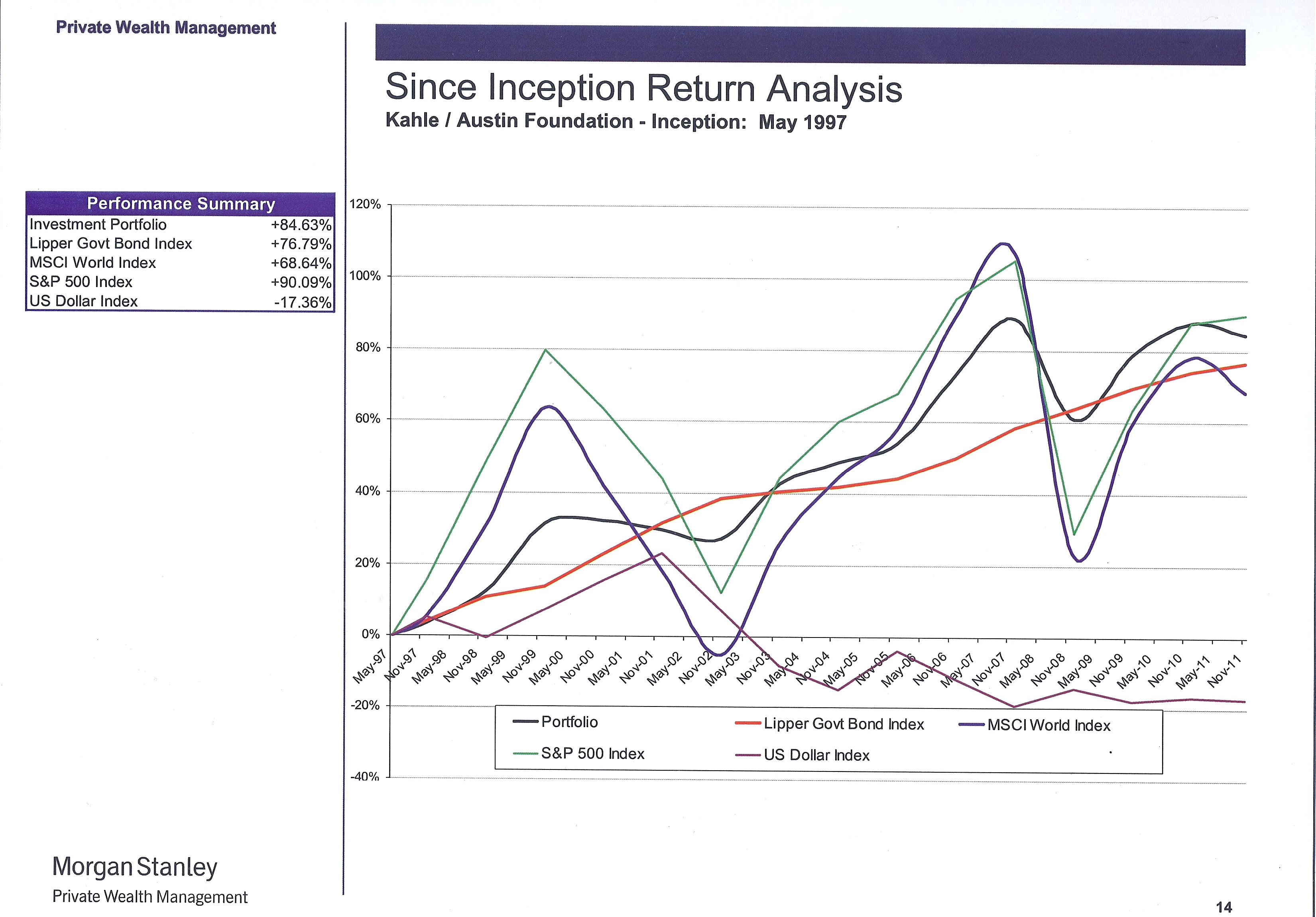
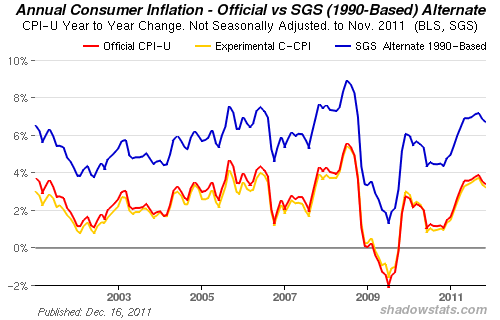
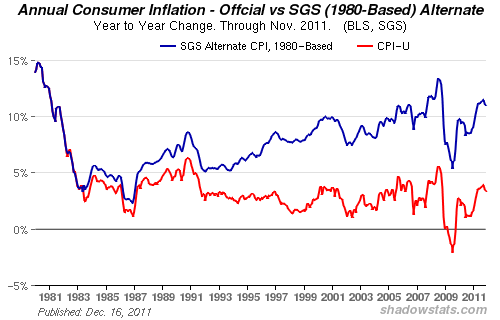
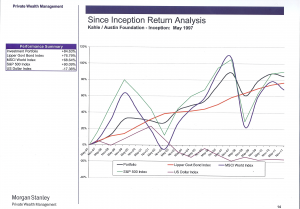
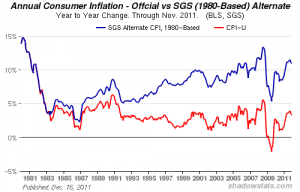
As an example, the return on the holdings of the Kahle/Austin Foundation managed by Morgan Stanley over the last 15 years has returned 4.3% per year on average which is almost 2% over the while the federal rate of inflation over that period of 2.4%[10].  If we use alternative inflation metrics, for instance based on the formulas used by the US government in 1990 or 1980, the inflation rate is 2 to 5% higher making the return for the Foundation possibly less than inflation[11].   This 15-year period has spanned economic cycles and is invested in a way that may be typical for smaller foundations so this return might be representative.
Inflation using 1990 method of calculation
If money during that period had been invested in housing, then for every $1 million in down payment, then it would have bought $5 million in housing in 1996.   Even at today’s prices (and therefore ignoring both inflation and the housing boom), this would purchase about 20 housing units of 1000 square feet each in a good neighborhood of San Francisco.    If a second mortgage were not taken out, but rather the housing units would be used for employees as a surplus was accumulated, then by one metric, about 5 subsidized units would be available.  The other 15 units would still be rented out at market rates to continue paying the mortgage.   The units would be worth approximately $2,000 per month, or $24,000 per year, but would be available for 75% less to public benefit employees, which would be an $18,000 benefit per year.   Even with only 5 units subsidized at this point, then it would already be worth $90,000 per year in benefit to the non-profits.     By the end of the 30-year term, this endowment would be worth $360,000 in benefit per year to the non-profits.     While difficult to exactly compare the financial return in a bank account, this level of enduring and direct benefit could motivate donors.

Therefore it could be seen as a good form of endowment for non-profits to invest in local housing for their employees and instead of taking the increase in the endowment as cash from investments.

Potential social impacts

To muse a bit, what might the potential social impacts be of having, say, 5% of city housing be debt-free?   These houses might be quite invisible during normal times but during debt crises or recessions, they could serve as an anchor or a stable point for a community in turmoil.    With others foreclosing or under large stress, public benefit workers could be in a strong position to provide social services such as healthcare, food, education, and emergency housing.

Furthermore, in times of crises, these organizations might attract new members and copycat organizations.   Thus the idea of debt-free life could serve as an active exemplar for others in a way that could cause the system to grow significantly.   Similar housing developments could spring up in the same locale and far away in such a way that debt-free housing could spread and develop.

Models of taking single-family houses and making them debt-free could develop as well.[12] Historically people did not move as often, and houses would be paid off and passed down to family members, essentially debt free.    If this new system were designed correctly, then we could realize some of those same benefits without restricting people’s movements.

New sources of houses to become debt-free could also come from elderly people that do not intend to pass on all of their wealth.  Thus as an alternative to selling one’s house after one dies, one could donate it to a non-profit to manage debt free forever as a form of donation to a cause.   Ensuring an enduring legacy, and an associated tax benefit, could be attractive to some people.

By staying removed from direct government funding, these housing units could be immune to conservative swings that tends to sell public assets to private companies.  These houses would only depend on the laws of private ownership and therefore could be somewhat resilient from political interference.

Protections from debt more generally could become a point of discussion if this model demonstrates benefits.  We might see other types of debt-free environments be created such as debt-free farming, debt-free education, debt-free healthcare, who knows.  This subject of debt resistant or debt free organizations may not have been systematically broached since usury stopped being illegal as well as a sin in Europe beginning with the Protestant Reformation.    But with the recent financial crisis reminding us of the periodic nature of debt crises, this could be a good the time to create new models.

Since 95% of all money is created by banks by lending money, thus creating both debt and money at the same time, then if we were to move to having significant parts of our lives to be without debt, then the amount of money that is available to be accumulated is diminished.  This could have significant and positive effects on limiting the concentration of wealth by a few, thus limiting extreme wealth disparities and the instabilities that follow.

Therefore, creating debt-free housing for public benefit employees seems to be both beneficial and possible.   This way we could build some resilience into some of our trusted institutions in the face of economic fluctuations.   The idea of living debt-free might even work more broadly to keep a larger part of the population out of debt for some of their necessities.   So far, I only know of a small group of people are currently discussing this, and I am posting about it on my blog on at http://brewster.kahle.org.    I welcome all input since this seems to be a step worth exploring.


Appendix A:


INTERNET ARCHIVE SCANNER GROUP ECONOMIC STUDY

September 2010

Jordan Modell, pro-bono project


BACKGROUND:


Goal: Try to get a quick reading of the economically based issues and concerns of Scanners earning $12-$14 an hour.


How:  Put together a quick questionnaire and spent Monday morning September 20th interviewing 15 workers (13 women and 2 men).  The 15 FTE divided into 4 races: Afro American, Central American, Samoan, and Asian.  Every person was forth coming, understood why were asking questions and was truly grateful for the study.


LEARNINGS:


1)   Lack of community and knowledge.   You have people in similar economic circumstances and in many cases the same country, yet there was no knowledge sharing on even basic social services or ways to “get by”.  For example transportation costs varied from 8% to 35% of income.   With the people paying the least being those who car-pooled (even lower than public transportation).

2)   Everyone had a phone and Internet access but only 85% had TV’s.   On average people spent $150+ month on Internet/Phone/TV.

3)   Rent/Mortgage was the top expense with phone/internet next, then food.  Of almost no concern were clothes and of little concern was health care.   The former is good news as people have learned how to work the system to buy second hand clothes or share among family.   Health Care is of concern as most have no insurance and rely on the republican moto of ‘Just don’t get sick’ as their way of coping.   65% knew where to get free of low cost care when sick but a surprising 35% did not or were not interested.


RECOMMENDATIONS:


SHORT TERM:

Using your size there are a few things you can do immediately that would make a difference in these peoples lives:


1)   Foster a sense of community.  Throw a guided themed dumpling/pizza parties that will get people to share how they cope with a lack of income.  Having more than one may be important as it takes time to foster a sense of sharing across so many races.

  1. Perhaps one could be on car pooling and you could have sign up sheets, route maps and ideas on parking.
  2. The second could be on different free health care options.  Et Al

2)   Use your size to see if you can better cell phone deals that do not expire if  someone leaves the Archive.   Competition is cut throat in cell phones and they may be able to cut their bills by at least 1/3.

i.     Do the same for dental care.  Even minimal care like filling cavities.

3)   Offer laptops at cost.   Most people were concerned with education and 15% actually sent their kids to a type of private school.


LONG TERM:

If you do end up doing a live/work space environment these are things you may wish to consider:


1)   Offer free wifi

2)   Offer shared cars – similar to zip car

3)   Start a mini school

4)   Know that people are paying on average $1,250 for accommodation so if you can get this to around $800 you will increase their income by 25% and their disposable income by a factor of 2-4.


Hope this helps.


Best….Jordan


[4] A government can help create more positive net-worth households by going into debt itself, but currently the dollar holdings of corporations and other foreign governments is absorbing this surplus thus pushing down the median net worth to close to zero.

[6] The Internet Archive scanners earn less than 1/3 of the median income of $95,000 thus fall into a category of “extremely low income” renters https://www.efanniemae.com/sf/refmaterials/hudmedinc/hudincomeresults.jsp?STATE=CA and “Fully 63 percent of

extremely low-income renters had severe housing cost burdens

in 2009”  http://www.jchs.harvard.edu/research/publications/americas-rental-housing-meeting-challenges-building-opportunities, where “Renters with severe housing cost burdens pay more than 50% of household income for rent and utilities.”

[7] Table A5 in http://www.jchs.harvard.edu/research/publications/state-nations-housing-2009 (13,615+9,172/75,512 and 2,753+5,215/12,271)  and Table A5 in http://www.census.gov/hhes/www/housing/special-topics/files/who-can-afford.pdf

[10]http://www.inflationdata.com/inflation/Inflation_Calculators/Cumulative_Inflation_Calculator.aspx   From May 1997 to November 2011 CPI is 41.31%, or an average of 2.4% per year, and the Kahle/Austin Foundation investments made 86% which comes out to be 4.3% per year, or almost 2% over inflation.

[11] Inflation is calculated by an independent group, from government data, but using the methods from 1990 and 1980 yielding higher inflation numbers: http://www.shadowstats.com/alternate_data/inflation-charts

[12] http://brewster.kahle.org/2011/06/11/housing-trust-leveraging-free-and-open-source-software-ideas-to-improve-housing/

Posted in Housing | Tagged , , , , , | 5 Comments

Structural Problem with our Mortgage-based Home-ownership System

Unfortunately, as long as US homes are largely purchased with 30-year mortgages, we are going to see large price swings for houses as interest rates swing, and bail-outs are likely every time interest rates go up unless it goes up very slowly and inflation goes up to match.   This is a structural problem that is going to be difficult to avoid, since many institutions are dependent on this system including millions of voters.   At least understanding how this happens can help motivate looking for alternative systems, such as debt-free housing.

The structural problem stems from people buying as much house as they can afford, and how much house they can afford is based on the monthly payment. (http://www.bis.org/publ/qtrpdf/r_qt0403f.pdf)   I do not believe this is because people are greedy, but rather that competitive pressures cause the housing prices to rise to meet the market.    That is to say, if the majority of people were not willing to pay a particular amount, then the housing prices would change to reflect this.   This would not change the housing stock, it would just change the price it would sell for.   The above cited study shows that people are willing to pay what is determined by the percentage of income allowed by government mortgage guarantee programs (Fannie Mae and Freddie Mac).

“The 30-year loan first became broadly available by an act of Congress in 1954 and, from then until now, the vast majority of such loans have been issued only with government support.” https://www.nytimes.com/2011/03/04/business/04housing.html?pagewanted=2&_r=1&partner=rss&emc=rss

If this government support program were to disappear, then housing prices would fall since banks are unlikely to give more favorable terms, or they would be giving them already.   Since so many people and institutions would suffer with a general fall in housing prices, it will be politically difficult to take away this program.

The next step is that given a monthly mortgage rate, the price of the house is a straight calculation based on the interest rate—for a given monthly payment, the lower the interest rate, the higher the price.   Monthly payments are based on salaries, since there is a formula that the federal mortgage guarantee entities use to calculate this. (http://www.census.gov/hhes/www/housing/special-topics/files/who-can-afford.pdf)

The price is largely set by the monthly mortgage that people in the area can afford, rather than the worth of the house.   In the 70?s and 80?s in the United States the mortgage payments were set at a maximum of 28-29% of income to be guaranteed by the government.     These regulations were loosened during the 2000’s which helped create the housing bubble thus the bail-outs and foreclosure boom that is going on now. But interest rates are at historic lows, with government guaranteed 30-year fixed mortgages at less than 5% interest.   When this interest rate raises, then either housing prices will fall or monthly payments will have to rise.   Monthly payments are based on salaries, which in turn are changed based on inflation.    Housing prices falling will cause more foreclosures because more houses will have an outstanding mortgage for more than they are worth, and mortgage holders will not be able to move out of a house based on selling it, so will have to foreclose if they want to move or can not afford the monthly payment for some reason.

Will inflation raise salaries enough to compensate for a raise in interest rates?  It does not appear so, unless interest rates rise very slowly.    A $250,000 dollar loan at 4% interest costs $1200 per month, yet if the interest rate went up to 10%, then the cost would be over $2,100 per month.  The salary would have to double to afford this increase.  Doubling based on 7% inflation would take 9 years (see below).    So as interest rates increase, inflating salaries will likely lag, thus causing a downward pressure on housing prices.

With 30-year mortgages, the fluctuations in interest rates will likely cause housing prices to fluctuate more than inflation can even out.   Housing price decreases cause foreclosures, and enough foreclosures cause bank failures or bail-outs.    Debt-free housing avoids this, but that is the subject of other posts.

Option 1 Option 2
Loan amount $250,000 $250,000
Interest 4% 10%
30 year-fixed 30 30
Monthly bill ($1,193.54) ($2,193.93)
fannie regulation 29% 29%
min yearly salary $49,388 $90,783
inflation estimates 1% 7%
years to inflate salary 7% $90,797
years: 9


Posted in Uncategorized | Tagged , | 6 Comments

Custom Schooling Workshop at the Internet Archive on Wed, Jan 11, 2012

Custom Schooling Workshop in San Francisco

Everyone is welcome to the first workshop on “custom schooling“, an approach to schooling with class sizes from 1 to 4 that is surprisingly affordable, manageable, effective, and fun.    Families and teachers that are doing this will discuss their experiences, but the emphasis will be on public Q&A.

Who might be interested?   Families and kids that might want to try this, teachers and school administrators, and, well, just about anyone who is interested in new ideas in education.   We are hoping about 40 people will come, but have room for more.

6-8:30pm Wednesday, January 11, 2012:
reception and tour at 6 then presentations and discussion at 6:30.
Presented by the Internet Archive and ISKME.org
Internet Archive, 300 Funston Avenue, SF CA  (map) 415-561-6767
Donation:  5 bucks or 5 books, none for under those under 20

Presentations will available via video for free on the Internet Archive a few days after the event.

RSVP appreciated.


Posted in Uncategorized | 4 Comments

Career Advice for a Better World: Food, Health, Housing, Education. Pick One.

Food, Health, Housing, Education.    Pick One.

If we pick a big goal, a high goal, a worthy goal, and then work to make a difference, then we might make some progress and avoid some of the classic pitfalls.   A worthy goal, and one that is ultimately unattainable, is helpful because it can be a guide to us through the years.    When there is a time of change, we can check back and see how we are doing and set out once again on our path.

Picking a goal we can attain has that problem of what do you do if you *do* attain the goal.   Laurie Anderson pointed this out in one of her performance art pieces:  What if you are Ahab and you get your white whale, what happens then?   Well, you go down with it.    This seems to be a problem with the “be happy” or “become a millionaire” approach.    Furthermore, if you do not attain your attainable goal, then you might feel that you could have and you are a failure.   Therefore strike out for an unattainable goal, but one that gives direction.

Danny Hillis, a mentor for me, and a student of Marvin Minsky who has been working on such a goal all his professional life:  “Artificial Intelligence”, gave me the advice to strike out for the big goal rather than focus on the incremental steps.    This is not to say to not work on the incremental steps, but I took the advice to mean that I should communicate with the world and with myself what I really wanted to do.   For me that was building “the great library”, the “library of alexandria version 2”.     This turned out to be very good advice, which I took to heart.    It has guided me ever since.    When I sold a company to AOL, and then left it, I was at odds.    I remembered Danny’s advice, remembered my own goal from years before and struck out, once again, to build that library.

Food, Health, Housing, Education.      Each of these goals need real help.   Each of these areas of our lives is seen to be in trouble.    Each needs long term, steady help.     And, as an extra bonus, others perceive these as good goals so they are likely to help those that are striving to help.

Food.    We have figured out how to have robots and servants grow our food.    Neither is a good solution and we are seeing the problems now in the form of land misuse, obesity, labor and immigration issues, overfishing, and periodic food scares.      We can do better than this.   If people not only knew their farmers, but took active part in growing their own food, we would have a safer, healthier people and planet.

Health.    Beyond healthcare, this is Health.   How are we living, eating, and relating to each other.    We have professionalized the health profession to such an extent that we believe our health is fully dependent on others.   We “outsourced” our understanding of ourselves.   To tend to our bodies, we can be living healthier lives– making sure our food, air, water, and daily activities build healthy bodies, families, and communities.    There are new tricks we can use to help us monitor and compare the signals from our bodies.    These tricks are a piece, but health is a broad and important barometer on well being.

Housing.   Some are focusing on Energy, but if we focus on housing instead, including where and how we work, then we may get to broad solutions that save energy, time, and stress.    If we pull up from the issues of how are we going to make more gasoline, and figure out how to keep people from commuting (which no one likes), or excessive business plane travel, we may have solved more problems than just energy.    Housing is also related to how our families and communities work.   The isolation from our friends causes the rise of such things as Facebook.    Isn’t that a poor substitute for being with the people we cherish and learn from?     Focusing on Housing can bring us together while helping us grow and stay young.

Education.    Notice this is not “schooling.”   Everyone has something to learn, everyone has something to teach– lets build lifelong systems of growth and sharing.     It is natural to who we are; we just got out of the habit somewhere along the line.    Lowering the bar to allow many to feel that they are full-fledged teachers.    Lowering the bar so everyone can feel they are still a student.    Changing the success metrics from sticks and tests and awards.    Lets educate our selves, our children, our parents, our neighbors in ways that feels good and healthy.

Picking a high goal and then making a difference can help straighten our paths and give our lives a theme.   If we had a generation focus on Food, Health, Housing, Education, we could have a better world for us all.   If we pick one for ourselves, then others will know how to help us on our journey, and we will know what to put on our tombstone.

Onward!


Posted in Uncategorized | Tagged , , , , | 5 Comments

Debt-free Housing for Public-Benefit Workers

A growing number of non-profit organizations are appearing to solve all sorts of public benefit missions from health, education, assistance for the less fortunate.  Those that decide to work in these non-profit organizations often forgo  some of the financial rewards of those working in for-profit sectors.    Some large non-profits or government jobs offer job security and retirement benefits that are not common in smaller non-profits.    If we can provide some of these benefits to the workers in smaller organizations, then we might have further incentive to attract and retain people in this valuable sector.

I propose that we create subsidized housing for those that work in smaller public benefit organizations by recreating debt-free housing.   If we do this well, we can support many non-profits at one time, and can do this without government subsidy beyond possible tax waivers that come with to non-profit organizations.

I have been using the words “public benefit” rather than “non profit” because there are now non-profits that are simply political lobbying organizations that are used to hide the identities of rich donors in order to bend public policy.   While these are still officially non-profits, I do not take them as the same as charity work in that they are often highly paid political operators.   Since those groups are leading to law changes, we may see the “non-profit” structure in the United States be exploited and even destroyed in the future.  To distinguish those working for the public good from all non-profit workers, I will use the term “public benefit workers”, and it may need further definition that does not revolve around United States law.

What is debt free housing?   Debt free housing is housing that does not have a mortgage or any financial loans against it.    In some areas, such as San Francisco, it makes up the vast majority of the cost of housing.    The rest of the cost is in maintenance and taxes.  Therefore if we can get rid of the debt and keep it off, then rents can be much lower.

How would we keep housing debt free?   Since it is so tempting to take out loans, as we have seen in the housing bubble on the 2000's, we need strong prohibitions on this.   Specially created non-profit organizations that have part of its charter and pledges by board members could provide enough protection.    But better yet is for those that live in and run the housing units understand the benefits that they have accrued by this stipulation and feel a responsibility to pass on the benefits to others.

How do we create debt free housing?   Either people will donate housing or we will have to work off the debt.    Both are plausible, but the later has an advantage that it might spread rapidly.     With a long enough time horizon in mind, a non-profit could use seed money to buy an apartment building this could be done with a mortgage and rent it out at market rents.       These market rents approximately cover the cost of running the building including the mortgage and eventually would be paid off.     Even before the typical 30 year mortgage is paid off, the building will be charging more for market rents than it costs because of inflation.       At that point, the surpus, or profit, can be used to provide subsidized housing units or put cash back into some public-benefit organizations.    A portion could be used to buy more apartments, or at least pay back for the initial down payment from the funding non-profit.

How fast can these housing units be created?   It depends on how much upfront money is used to buy houses or if houses are donated.   It also depends on how fast units are paid off with market rents.     Lets calculate the first:  If we have a $1M non-profit that wants to buy housing, and if we assume that a 20% down payment is required to initially buy an apartment building, then the non-profit can by a $5M apartment building.   If the initial market rents are used to repay the non-profit the initial 20% by taking out a second loan (the last loan it can ever take out!), then this will depend on inflation or interest rate changes and the like.   If we estimate that this loan can be acquires in 7 years, then the non-profit can buy yet more housing units.   In San Francisco, a 1000 square foot apartment costs about $350k, so a $5M initial investment would by 14 units.    So every 7 years, there would be 14 more units going towards being debt free.    So for $1M in upfront donation to the non-profit, there would be 2 units per year.

How long will it take for a housing unit to become debt free?   If 30 year mortgages are used and these are never renewed, then at least it will be debt free in 30 years.    But given that inflation reduces a fixed mortgage relative to market rents, many of the units will be effectively debt free in a shorter period.   San Francisco is extreme because of its high cost of housing and low taxes, but maybe half of the units can be at half the prevailing market rents in 15 years, and the rest following rapidly.

How does this compare to other ways to invest $1M?    If we assume that rate of return can be 5% over inflation (which is much higher than my experience, but it is what is estimated in university endowments), then there is $50k each year, inflation adjusted.   In San Francisco, a rental unit is typically $2k per month, or $24k per year, so a $1M investment would support 2 housing units forever, or 4 units at 1/2 market rent.     Above we estimated that 2 new units would be created each year, but these would only start to become available after 15 years.    So this is not a system for immediate gratification, but has a strong long term benefit.

Fortunately, if we have $10m or $100m to start the program, or if apartment buildings were donated then we could start this program quite quickly and benefit thousands of families.     If we wanted 1000 housing new units per year to become permanently subsidized housing, then it would require donations of housing units or initial donations of $500M.    If a bank would allow less than 20% down payment than much more could be done with much less.

Posted in Uncategorized | Tagged , , | 1 Comment

Essense of Richard Stallman’s Free Software Idea

Can a system support the benefits to many entities that had previously been confined to a single entity?

Furthermore, can this be done without support of law or government, since laws can be reshaped to benefit the few at the expense of the many?

I believe the answer is yes, and with Richard Stallman’s Free Software, we saw it in action: a form of sharing and mutual aid that is common inside an community or corporation, but not between organizations.    Inside a company, there is free license to use others works without compensation.   In the case of software, this would mean using each others software code and maintenance labor to help another group’s project.    In 1976, all written ideas were suddenly property, so cross-organizational efforts required explicit licensing.     This is especially difficult in the case of individual programmers that are not in an organization, or in an organization that does not do that kind of licensing, such as a University.

Therefore we have seen a system created that regulated a set of shared benefits between organizations that mimicked the efficiency in a pre-property world.

What kind of benefits might be shared in this way?   Housing is one.

Some types of organizations, such as Universities, Churches, and hospitals have operated subsidized housing for their community.  Universities house faculty and students; churches house priests and sometimes homeless people; and hospitals support doctors in training. When corporations created housing for their employees, in the form of “company towns”, the practice was often documented as becoming abusive, so is largely gone.    (The town of Empire Nevada was  company town built by a gypsum mining company, which was the last company town in Nevada going out of business and evicting everyone in 2010).

Is there a way to have a set of housing that is subsidized for the benefit of many organizations of the same type rather than for just one organization?    There is subsidized housing for some groups of people, such as low-income families, set up by the government, or regulated by the government.    If the government did not require these houses to be built they are unlikely to be built and sustained.

So how about another class?   I believe there may have been housing for union members, but I am not sure of this. (anyone know?)

Can this work for those that choose to work in non-profit or public-benefit organizations, whether it be all such organizations or a set of them?  Therefore, a set of housing units can be developed for those that want to work in these organizations as a form of subsidy that would be enduring.

If we could get the incentives right, as Richard Stallman did, we could have housing for public benefit workers that provides an ongoing subsidy to those choosing to serve the public.   If done right, then there would not need to be government subsidy or even specific laws past to do this.

Posted in Uncategorized | Tagged , , | 3 Comments

Michael Hart of Project Gutenberg Passes

A dear friend and an inspiration unfortunately died yesterday.  Washpost obituary.

He dedicated his life to getting books to everyone in the world. He did
this with no compensation and lived a life of near poverty. But he
always shined with good cheer, optimism, and high respect for others. I
got to know him through Project Gutenberg twenty years ago. Visiting him
in his house was a joy– it was stacked high with books all around, and
a glowing green terminal in the basement where he first helped type in
the classics and then lead thousands of volunteers to bring over 37,000
books online as beautifully edited ebooks. A forward thinker, in the
same light as Richard Stallman and Ted Nelson, who saw how the world
could benefit from our digital tools. Every reading device I have ever
come across always started with the Gutenberg Project collection
including our Internet Bookmobile.

On first meeting him, I remember dodging traffic with him as we walked
calmly across Lakeside Blvd in Chicago (which is a highway and extremely
dangerous). He said he did this in normal course when he was growing up.
The cop let us get away with only a warning.

Another Michael flare is that he wrote email that was “right justified”
by changing the words to end at the right place– I have never known
another to do this. He said that he did this to avoid text editors
reflowing his text and “destroying my phraseology”. For instance below
are two letters from this summer, and I included Greg Newby’s obituary.

A special man, a guiding light, a good friend. I miss him.   Lets build that billion book library that he is dreaming of.

-brewster

On 7/16/11 4:38 AM, Michael S. Hart wrote:

A Graceful Exit

As most of my friends know, I have accomplished all of the goals
I have set for myself throughout my life, and I think I can say,
without fear of too much repercussive responses, that the career
I have chosen in eBooks has been a success in terms of what I've
been trying to accomplish for these last four decades.

At the same time, I do realize that other persons have had other
ideas/ideals about eBooks, who have called me everything from an
outright raging Communist, to sincere Socialist, to unqualified,
in terms of membership. . .not ability. . .member of Capitalists
Exploiting The World. . .no kidding.  I do realize that is might
be difficult for persons living on the other side of this world,
given the information they have to work with, to view me, or any
other American, as anything other than a Capitalist Imperialist,
so I bear less in the way of ill feelings about this.

However, now the time has come to talk of other things.

Yes, I do have one more impossible goal I dream of, but I do not
believe I can accomplish it in the same manner I accomplished an
assortment of previous goals, with a combination of persistence,
ability, and convincing others to give me unofficial assistance,
as I face a combination of limited time, limited resources and I
must admit, declining energy levels, though I still manage to do
more work than I ever did before.

However, I do realize that without some serious changed in life,
there is little possibility of accomplishing my last goal with a
lifestyle continuing in the same vein.

Therefore, I now would like to remind you of my last goals:

1.  A Billion eBook Library

2.  Spending More Time In Hawaii

3.  Working To Create A Graceful Exit

Here are the details:

A Billion eBook Library

Premise #1:

There are ~25 million books in the public domain.

If we do ~40% of these that will be ~10 million eBooks.

Premise #2:

There are ~250 languages with over a million speakers.

If we do ~40% of these that will be ~100 languages.

Conclusion:

10 million eBooks translated into 100 languages yields

ONE BILLION eBOOKS

Note:  I realize how impossible this sounds, given the
powerful lack of interest by thousands of translators,
and other experts I have contacted, but given previous
personal experiences shared by each of you and myself,
I think we must realize it IS possible, even if we are
going to have to do all to much of it ourselves.

Nevertheless, I plan to devote a serious amount of the
time I have remaining to doing the setup required.

2.  Spending More Time In Hawaii

As most of you know, Hawaii was just too laid back for
me to stay there more than a month at a time when this
opportunity first appeared.

However, you must also realize that from 1999 to 2011,
I obviously have aged 12 years, and the difference for
me between 52, when I could still pretend to be ~40's,
and today, when there is little pretending possible, I
am now much more likely to spend at least half my time
there, if not even more, given that I might expect the
pressures to increase to abandon my Illinois residence
for various and sundry reasons we should maybe discuss
when we get together next.

However, I can tell you that pressures of Winter, here
in Illinois, plus those of advancing age, make it more
and more difficult to look forward to more of this.

I should add that even though Spring is my favorite of
all the seasons, this spring was an effort, but with a
lot of luck I once again managed to do all I planned.

However, I must also admit that this, too, will get to
be more and more difficult as the years progress.

Therefore I am very glad to announce that I have a job
with John in Hawaii that will, when needed, provide me
with the ability to live in a neighboring apartment to
John's for as much of the year as I would like, and we
will see how this works out starting this Winter.

3.  A Graceful Exit

I would like to support all the efforts I have before,
plus the final one I have listed above, without any of
repercussions that could take place with I shuffle off
this mortal coil.

In some ways I would like to simply work behind scenes
as much as possible so I won't be missed when I'm gone
from those activities, but I also realize that my name
just might be worth something in public relations so I
leave some of that decision open for your advice.

As John and Greg can testify, I am still capable of an
awful lot of Newsletter writing, though it does take a
toll, particularly when I have lots more to do for the
other portions of my life.  Again, I leave this open a
lot for your advice.

Please refer to the previous message I sent about work
on setting up a new, and much different kind of setup,
for The Billion eBook Project, I will resend it.

If I/we play our cards right, perhaps I can leave this
scene without causing undue trouble, and perhaps I can
even manage it in absentia as some kind of motivation,
perhaps setting some goal, perhaps even some rewarding
procedures for accomplishment.

I, personally, do not think the world at large really,
sincerely wants to provide literacy and education from
anyone to The Third World, in spite of all lip service
to the contrary. . .so I warn you that the possibility
exists that this project will not be supported from an
outside set of sources that I still plan to approach--
so you might find that you are more on your own that I
would like to hope, and that you might have to expect,
really, a future that is more like the past, in terms,
sadly to say, of having to do a LOT of this work on an
individual basis more than having the world's support.

I hope you feel up to the task. . .you will be tempted
more and more to rest from exhaustion as you get older
and older. . .the all nighters will turn into just get
up early when the air is clear, but you will also find
that what you can accomplish in those fewer hours will
be more than you ever did before, because experience's
power is greater than you might think today.

That is what I leave you with. . . .

Another goal that is nigh well on to impossible.

Little hope of finding any real world support.

And the hope that your experience will leverage future
endeavors for you as much as it has for me.

I hope you can put enough into these efforts that I am
able to depart as gracefully as is possible these days.

Hoping to thank you soon for your time & consideration,

Michael

On 8/9/11 4:18 PM, Michael S. Hart wrote:

The Impatience of Olde Age:  Part 0

With your permission, the three of you, I would like to start
presenting via email what I had intended to wait until we are
all together in once place at the same time.

This past 10 day, up until yesterday, I had been working just
about as hard as I possibly could every single day to get the
house and everything else prepared for my upcoming trips from
here to John's in Hawaii and Brewster's in San Franscico, for
the purpose of doing this in person, and it sill might happen
that way, but I just do not have the patience to wait and see
how it all works out.

So, please RSVP ASAP and give me permission to start sending,
in hopefully easy to digest pieces, some messages about those
steps I have in mind for the future.

Hoping to thank you soon for your permission,

Michael

This is an obituary from Greg Newby, a close friend of Michael–

http://www.gutenberg.org/wiki/Main_Page

Michael Stern Hart was born in Tacoma, Washington on March 8, 1947.
He died on September 6, 2011 in his home in Urbana, Illinois, at the
age of 64.  His is survived by his mother, Alice, and brother,
Bennett.  Michael was an Eagle Scout (Urbana Troop 6 and Explorer Post
12), and served in the Army in Korea during the Vietnam era.

Hart was best known for his 1971 invention of electronic books, or
eBooks.  He founded Project Gutenberg, which is recognized as one of
the earliest and longest-lasting online literary projects.  He often
told this story of how he had the idea for eBooks.  He had been
granted access to significant computing power at the University of
Illinois at Urbana-Champaign.  On July 4 1971, after being inspired by
a free printed copy of the U.S. Declaration of Independence, he
decided to type the text into a computer, and to transmit it to other
users on the computer network.  From this beginning, the digitization
and distribution of literature was to be Hart’s life’s work, spanning
over 40 years.

Hart was an ardent technologist and futurist.  A lifetime tinkerer, he
acquired hands-on expertise with the technologies of the day: radio,
hi-fi stereo, video equipment, and of course computers.  He constantly
looked into the future, to anticipate technological advances.  One of
his favorite speculations was that someday, everyone would be able to
have their own copy of the Project Gutenberg collection or whatever
subset desired.  This vision came true, thanks to the advent of large
inexpensive computer disk drives, and to the ubiquity of portable
mobile devices, such as cell phones.

Hart also predicted the enhancement of automatic translation, which
would provide all of the world’s literature in over a hundred
languages.  While this goal has not yet been reached, by the time of
his death Project Gutenberg hosted eBooks in 60 different languages,
and was frequently highlighted as one of the best Internet-based
resources.

A lifetime intellectual, Hart was inspired by his parents, both
professors at the University of Illinois, to seek truth and to
question authority.  One of his favorite recent quotes, credited to
George Bernard Shaw, is characteristic of his approach to life:

“Reasonable people adapt themselves to the world.  Unreasonable
people attempt to adapt the world to themselves.  All progress,
therefore, depends on unreasonable people.”

Michael prided himself on being unreasonable, and only in the later
years of life did he mellow sufficiently to occasionally refrain from
debate.  Yet, his passion for life, and all the things in it, never
abated.

Frugal to a fault, Michael glided through life with many possessions
and friends, but very few expenses.  He used home remedies rather than
seeing doctors.  He fixed his own house and car.  He built many
computers, stereos, and other gear, often from discarded components.

Michael S. Hart left a major mark on the world.  The invention of
eBooks was not simply a technological innovation or precursor to the
modern information environment.  A more correct understanding is that
eBooks are an efficient and effective way of unlimited free
distribution of literature.  Access to eBooks can thus provide
opportunity for increased literacy.  Literacy, the ideas contained in
literature, creates opportunity.

In July 2011, Michael wrote these words, which summarize his goals and
his lasting legacy: ?¢‚Ǩ?ìOne thing about eBooks that most people haven’t
thought much is that eBooks are the very first thing that we’re all
able to have as much as we want other than air.  Think about that for
a moment and you realize we are in the right job.”  He had this
advice for those seeking to make literature available to all people,
especially children: “Learning is its own reward.  Nothing I can
say is better than that.”

Michael is remembered as a dear friend, who sacrificed personal luxury
to fight for literacy, and for preservation of public domain rights
and resources, towards the greater good.

This obituary is granted to the public domain by its author,
Dr. Gregory B. Newby.
_______________________________________________
gutvol-d mailing list
gutvol-d@lists.pglaf.org
http://lists.pglaf.org/mailman/listinfo/gutvol-d

Posted in Uncategorized | Tagged , , , | 26 Comments

AP piece on the Physical Archive of the Internet Archive

The AP wrote a article and made a video about the physical archive of the Internet Archive.   This is our storage system for millions of books that I wrote about on the Archive Blog.   We hope to expand it to music and movies as well.

Onward!


Posted in Uncategorized | 7 Comments

Growing Our Own Food

Leveraging recent developments, I believe we can build small-scale farms that are low-labor and low-water-usage that grow enough chickens, fish, and vegetables (not sure about grains) to feed many families.   Small scale meaning less than 1 acre and low labor meaning it does not take over your life.   A gentleman’s farm that actually feeds a community.

This can bring us healthier food and lifestyle as well as a sense of food security.   Serving as a model and example for others in case of a food shock, some bottom-up research and development could help society in the case of need.

I wrote an essay about my researching the subject.

But please read and comment.   Word File, PDF, other formats.

http://www.archive.org/details/GrowingOurOwnFoodAndOtherEssays

aquaponics


Posted in Uncategorized | Tagged , , , | 4 Comments

What should be the school year be for custom schoolers?

Our family has built a “custom school” around our 14 year-old child with hired teachers, and it is working out fantastically well.    He is learning more than his former classmates, according to his former teachers that have evaluated him.   He is excited about reading a wide range of books, which is new.   And I am glad he is learning the beauty of mathematics, not just the mechanics he was taught before.    Together we decided to continue for another year at least.

But what should we do about the school year?   Should we match his older brother’s high school schedule?    We started out the year that way, but have changed.   He now takes a class whenever both he and his teacher is in town, and we feel free to have him take trips with us all through the year.   Right now is now at a 2 week birder camp which he saved his allowance for.   The teachers have been thankfully flexible with our schedule, and it we are flexible around theirs.    So we have adopted a flexible schedule that has many weeks off each year, but not all gathered together.

This has allowed us to go on trips together, for his teachers to take him on field trips, and for him to stay learning more consistently.    A language teacher complained that the summer months set students back by many weeks.

There is value to having time off to play, relax, and develop hobbies, but is our spreading this out throughout the year a better course?    It is too early to tell, and I am not quite sure how we will be able to tell, but our son does not seem to feel that he is being cheated out of summer vacation– he is getting trips and independence sprinkled throughout the year.

If anyone has any experience with this, please comment here, or write to us.


Posted in Uncategorized | 2 Comments