
Debt Free Housing

Debt free housing would cost a fraction, and probably a small fraction, of what most of us pay now, whether we own or rent.   As I argued before, most of the monthly cost we pay for our housing goes to finance fees rather than maintaining our houses.   Even if our houses or apartments are over 30 years old, and therefore should be paid off, they come back to be be refinanced, resold, second-mortgaged, or just profitable for the owner because they the prevailing rent assumes a debt burden.

How do we get to debt free housing in this current circumstance?   We now have houses that have artificially high prices because of the debt system , and we have people not paying off their mortgages because of 30 years is longer than they stay in their houses.   And furthermore, owners want to cash out because it is probably their largest vessel of their wealth.

So we have a puzzle– the tax and pricing system is built to support chronic and risky debt burdens that are perpetuated from generation to generation.     I will propose a system that breaks this cycle, one house or one apartment building at a time, that can permanently remove housing units from a debt burden and hopefully spread.    But it take some investment and patience, but mostly it requires wanting to give a gift to the future.

The fundamental idea is to pay off a house or apartment block once, and then keep it from being burdened with debt ever again.    This requires building long term entities that have at their mandate to have this long term view, then find low cost way to build these entities, and finally find people that would find this desirable to do.   This is not a new idea, and there are variations, but I will outline one way through this thicket that has some advantages.

Lets take an existing apartment block in a city that already has tenants, but is for sale.   Lets create an non-profit entity that has a specific charter to be a “public benefit organization” with certain covenants in it that ensure that it will stay on track.   This entity then buys and mortgages the property with a fixed rate 30 year loan with a 10% down payment.   I will get to who would be motivated to extend this money in another post, but lets examine the financial case for those that might want to.    Since prevailing market apartment rents are generally set to pay for such expenses, the rents can approximately pay for the mortgage.   If there is inflation, then the prevailing rents would rise relative to the fixed mortgage payment and then there is latitude to either lower the rents in our apartment block, or use the money for something else.    If there is deflation and rents fall, then there is a possibility of defaulting on the mortgage and losing the 10% down payment.  This a risk of default assumes we do not have an external source of money and lets assume in this case we do not, so this is a risk.    Since deflation is linked with all other housing there is great interest on the part of the government to not have this happen, as we are seeing in the housing crisis of 2007-2011– and they take efforts to prop up housing prices at taxpayer expense.   Without a major round of deflation, in 30 years, the mortgage would paid off and then there is an ongoing revenue stream that can be used in some way.   It is interesting to note, that this revenue stream would then be available forever after.

So after 30 years, and probably much sooner, the Public Benefit Organization that owns this apartment block can either charge under-market rent or spin off money for some purpose.    With a covenant to never get into debt again, and to never sell, this revenue stream or under-market rental properties can be available forever.

Who would be interested in investing in this way?   Who would benefit from creating debt free housing?    I suggest that there are groups of people, those doing the public good, those that have long term interests, that have these motivations.    Key to understand in this system, is that it does not cost much up front (maybe 10% of a housing unit), does not cost anything as we wait out the mortgage or for inflation to diminish the mortgage cost, and then the benefit is perpetual.

I will show examples of this system in action already, and how we can create a movement to do much more of this in future posts.
 

Posted in Uncategorized | Tagged , | 3 Comments

Mortgages can make our houses cost 500% more

I have been looking for evidence of what mortgages do to housing prices in the United States, which is not easy since mortgages are so widespread they effect almost all houses.  Finding an example to compare how much our houses would cost if we just did not have our mortgage system is therefore not easy.   But I think I have found one:  Atchison Village in Richmond, California.    This housing development is absolutely amazing for many reasons, but for now I will just focus on this one aspect.

Atchison Village is former defense housing made up of 450 housing units.   The whole village was purchased from the Department of Defense as a single parcel in 1956, financed with a mortgage that was paid off 20 years later (and the residents had a party and a mortgage burning).    The residents “own” their houses, but can not get mortgages from Bank of America and the like because Bank of America can not then resell the mortgages to Fannie Mae.    Therefore the houses cost between $30,000 and $70,000 according to wikipedia, but my investigations found they currently go for a bit above $70,000.      The reason they go for that much, we were told, was that was what the local credit union would lend a resident to help them pay for the unit.   It is not quite a mortgage, as there is no lien on the property.  It is more like an credit card loan– it is tied to the person.    (Interestingly they have had very few defaults in the 50 years of making these loans).

Therefore the price of these houses are based on what you can borrow to buy them.    This is an interesting result.

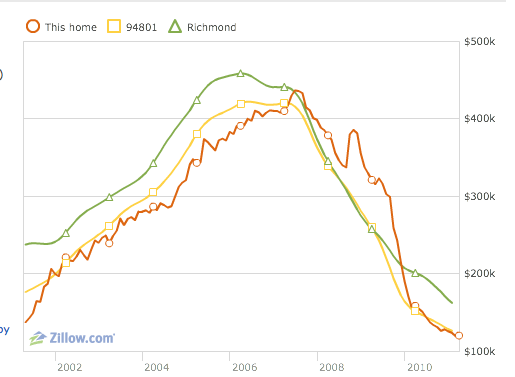
Houses just outside the gates of Atchison Village sold for between $400,000 and $500,000 during the housing bubble and they the neighborhoods are considered by many to be dangerous and worse.

Houses outside of Richmond did not get any better from 2002 to 2007, this had always been a dangerous and undesirable location.    What did change was what commercial banks would lend on a house because of the change in rules that Fannie Mae would accept for income to support the mortgage.

Therefore, it appears that houses will change their price based on what mortgages are available.   If interest rates go down, and therefore mortgage payments should drop, it seems that housing prices rise so that the mortgage payments stay the same.   Further, if people are permitted to dedicate more of their monthly income to mortgage, then, they housing prices will rise to assume that this is what is available.    Housing prices then would be correlated with interest rates and mortgage rules.   And this is what we saw during the 1990’s and 2000’s in the United States.

Since Atchison Village residents were denied commercial bank mortgages, then the house prices did not fluctuate anywhere near as much.   Further, the underlying price of the house was kept at a fraction of the houses in the same neighborhood.

Mortgages can make comparable or inferior houses cost 500% more than ones at the same time and same neighborhood.     This is an important result.     This disproves many of the assumptions of prices just being a factor of the market.    It really is a matter of policy of a poorly regulated government-guaranteed for-profit entity, Fannie Mae, and its risk-avoiding for-profit partners, the commercial banks.

Therefore prices are set based on the availability of mortgages and the monthly payment not based on worth of the house.    As interest rates go up, then prices will fall, and the tax payers of the United States will pay the price as they fall because we back Fannie Mae when disaster hits.   But when interest rates fall once again, then it will be others that make the profit as home prices once again rise.   Since there are so much money tied up in housing debt and this game is now well known and can be counted on, there are many standing to win the next time.

Monthly mortgage payments are the important factor then.    This does not seem very different from rent, in many ways, from a resident’s point of view, especially when the most common length of a mortgage, 30 years, is substantially above the average of 6 years that people stay in a house.   Some estimate the that mortgages are renegotiated less than every 3 years on average, so that means that most people are, in effect, always in debt and paying monthly payments.   A funny story on the lack of people paying off their homes was published by National Public Radio.

We now have an example of the price we are paying for our current mortgage system– much higher housing prices, tax payer bailouts, and perpetual debt payments.

So should we have mortgages on our homes?   If we want to encourage owners, that are not in perpetual debt, then we should not have the current system of mortgages.     We can do better.   Lets.   More on that in another post.


Posted in Uncategorized | Tagged , , | 1 Comment

Used Houses

I remember being shocked by the phrase “used house” as in “who would want a used house” since all houses where I grew up with were 60-100 years old– they were all “used”.    But it did get me thinking– why do used houses cost so much.  Once a house is paid off, either through waiting out a mortgage or inflation making the house payments essentially free, then why is it that one can sell the house again at a price as if it were new?

I don't think it should be a strange question to ask:  Once a house is paid off, why does it go to another buyer as a debt burdened property?

The answer is, because people will pay.   That people are willing to buy many used houses for the price of building a new house plus the land.   It is what the market will bear.     But why will the market bear it?

The price is largely set by the monthly mortgage that people in the area can afford, rather than the worth of the house.   In the 70's and 80's in the United States the mortgage payments were set at a maximum of 28-29% of income to be guaranteed by the government.

“Prior to the mid 1990s the federal housing enterprises (Fannie Mae and Freddie Mac) would not purchase mortgages unless the principal, interest, tax, and insurance payment (PITI) did not exceed 28 percent of the borrower’s income for a conventional loan and 29 percent for an FHA insured loan.” US Census Department

This effectively set the price of the house.    And it was highly leveraged on the interest rate.   If the interest rate fell, then loan payments on a set amount would fall, but since people paid 30% of their income, this meant that the price of the house would go up to compensate for the lower interest rate.

This got even worse, when in the 1990's the 28-29% rule was relaxed.   “The mid to late 1990s ushered in many less stringent guidelines.”    Therefore housing prices were allowed to increase further as interest rates stayed very low.

So the price of a used house stayed very high independent of what the house and property was worth.      How much higher than it would have without the mortgage system I will attempt to estimate in another post.

Posted in Uncategorized | Tagged , , | 1 Comment

Welcome to the Real World, You are Now in Debt

There has been a focus on the exploding problems of student debt, which are sinking a large population a critical point in their lives. But even if you are not under student loans, once you move out of your parent’s house you are effectively in debt– housing debt. The way this works is that if you buy a house it is usually for a mortgage, but if you rent, you are also paying off debt, and you dont even get the apartment once it is paid off. The landlord is either in debt or acts like it by setting the rent to cover the equivalent of the mortgage (because that is the norm in the competing rental market). Therefore, even if the apartment is 100 years old, it is not paid off, or at least the renters are paying as if it is not.

I believe that over 1/2 of someone’s rent is paying debt as opposed to paying for the upkeep of the house. Here is how this calculates out. In San Francisco, apartment buildings cost between $250-400 per square foot in reasonable neighborhoods. Rent in these apartments is $2000-$3000/month for 1000 square foot. At the current 5% mortgage rate (just the interest, not the principle) and a 1000 square foot apartment, the cost, just for interest on borrowed money is $1,350. Therefore in this circumstance, half of rent is for interest payments.   (Why the principle is also so high, is also because of debt, but that will be covered in another post.)

So paying renting is the equivalent of being debt, but without some of the advantages. For instance, after 30 years, you do not own that apartment. Also, if the value of the apartment goes up, you do not get to sell it for a profit, much to the contrary, your rent goes up to match those that are buying apartment buildings at the new higher rate. Now it is true that you can move out more readily, and if the price of the apartment building goes down, you are not as stuck, so there are some trade offs, but it is important, and in some ways
surprising how often we are really paying off debt when we think we are buying a good or service.

Even if the house is over 30 years old and would have paid off the original mortgage, the debt goes on. This is an effect of the commodification of objects– the ability to sell them to someone that is willing to go into debt based on the possibility of future earnings– means that house may never pass on the benefits of being paid off.

Some say that this is just the “will of the market”, but this “will” is just a made up human artifice that is now built into our institutions, government guarantees, advertising programs, and tax laws. It does not have to be this way. But undoing it will take being clever. More on how this might work later. But the key here is to see that debt is woven into more prices than just repaying loans.

Welcome to the real world, kid, you are now in debt.

Posted in Uncategorized | Tagged , , | 1 Comment

Cost of Debt in Housing

Is it practical to live debt free?  I would say yes, but it will take being a bit clever.   This is an important topic because I will try to show that for most Americans most of our housing cost is debt financing one way or another.    This post will attempt to show housing costs are a major burden on us and that a majority of our housing costs are debt financing.  In another post we will explore ways to live without debt service.

Most of us rent or own where we live, but it is getting to be unaffordable.   Housing is termed “unaffordable” to the US Census Department if we are spending more than 30% on it, but again according to the census, “the cost of housing was 33 percent of the current income for renter occupied units in 2007.” And even for owners, 37% of mortgage holders are spending more than that and those that do not have a mortgage have housing expenses of over 16% of income.    Since over  70% of those of us that own a house have a mortgage on it, and over 31% of households rent, almost 80% of American households are paying housing they can not afford.

Another analysis of this issue is that the average wage earner can not afford the rent of a 2 bedroom apartment, and 60% of wage earners can not even afford a one bedroom in their county.

So we have a problem in housing cost.   Why?   The cost of the debt is a large part of it.  Over half of our cost of housing is paying direct financing costs.

For rentals, this can be demonstrated based on how apartment buildings are sold, and also by the rent.   Apartment buildings are advertized and priced based on “CAP rate”, or capitalization rate.   This is the cost of running the building over the price of the building.   This is typically advertised at 5%, but often sell when they are 6-8%, and fluctuates based on the interest rate of mortgages.    If this amount goes below other investment opportunities, then people would not invest their money in the apartment building.   In other words, if one were investing one’s cash in a building, then it would have to be better than putting the money in something else.  This is typically estimated in a few percentage points above a mortgate rate.   If one were taking out a mortgage to buy the property, then the income we be expected to at least pay back the mortgage (this is sometimes not true in a speculator market, but these do not typically last long).    Analysis of the breakdown of costs to run the building, it is clear that only 1-2% are non-financial operational costs ( sample apartment building in San Francisco).    Therefore since rents are set based on maintaining a “cap rate” of 5-8% and the non-financing cost is 1-2%, then the vast majority of the cost of the apartment building goes into debt financing, or the equivalent calculation for investors putting in cash, where they in turn are financing the building and expecting a return.

In houses that are purchased, the debt service is also the vast majority of the early cost.   With the average cost of a house is around $300,000, and if there were the mortgage amount, then we would be paying about $19,000 for the mortgage.  The taxes are only 1.8%, maintenance may be 1% per year, and insurance is less than 1/3 of 1%.   So the dominant cost, by far is finance cost.

Therefore if we were able to not have direct debt financing costs, then over half of the cost of housing would disappear and would, then, be affordable to the average wage earner in the United States.

Posted in Uncategorized | Tagged , , | 1 Comment

Welcome

Welcome to brewster.kahle.org. This is a test post in the Food category/tag.

Posted in Uncategorized | Comments Off on Welcome